
Saturday, April 29, 2006
Border areas struggling..and so is Adams
Sinn Féin this past week held the northwest launch of the party's vision of a United Ireland, a vision no doubt that many unionists would be enamoured with!Party president Gerry Adams, vice-president Pat Doherty and chief negotiator Martin McGuinness were in Derry to oversee the launch and Mr Adams claimed that Partition had had "a disastrous impact" on border areas:
"The northwest is the poorest area of the poorest regions.
"We would argue that we cannot understand these problems or seek to solve them unless we view them in the context of partition."
I was with Mr Adams up to this point. Then, regrettably, he proceeded to drag up one of the most stupid, utterly pointless concepts his party has come up with in recent memory - the infamous 'green paper' on Irish Unity which none of the parties in the Dáil want to touch with a fifty foot barge pole.
The whole thing strikes me as similar to a whiny child writing up a Christmas list that includes a pony:
"But Timmy, Santa can't bring you a pony. It's just not possible. The pony wouldn't want to live with us unless we could provide for it."
"But I want a pony! Convince Santa to get me a pony!"
Sinn Féin seem to have forgotten that the onus is on them to convince unionists of the merits of Irish unity. But, alas, as Adams continued his speech, it was as if we were sucked into a time warp and taken back to 1986 rather than being able to deal in the present here in 2006:
"The Irish government has a responsibility to take the lead and develop a strategy for Irish self-determination."
What the Dickens is this all about? Does anybody have any clue what on earth he's on about here? Anyone?
"The British government should act as persuaders for Irish unity..."
Why's that? Isn't that your job? Shouldn't the job of the British government be to accept the will of the people? You know, govern?
"...and there should be an ongoing engagement with unionist opinion."
Um, here's a whacky thought Mr Adams. Why don't YOU and YOUR PARTY engage with unionist opinion? Wasn't that the whole logic behind the Good Friday Agreement anyway - the one your party signed up to? The GFA stated that, being a participant of the Agreement, you chose to:
"acknowledge that while a substantial section of the people in Northern Ireland share the legitimate wish of a majority of the people of the island of Ireland for a united Ireland, the present wish of a majority of the people of Northern Ireland, freely exercised and legitimate, is to maintain the Union and, accordingly, that Northern Ireland's status as part of the United Kingdom reflects and relies upon that wish; and that it would be wrong to make any change in the status of Northern Ireland save with the consent of a majority of its people."
And yet, rather than attain the consent of a majority of the people, bafflingly, Mr Adams instead wants the British government to persuade unionists to support a United Ireland!
Dear oh dear, oh dear!
And people believe these guys are going to be able to bring about a United Ireland? I don't think so.
Sorry Timmy, you can cry and moan all you want but Santa ain't bringing you that pony...
A Looney suggestion
Miss Looney said:
"It is this lack of responsibility that keeps Joe Duffy on the air, and pages and pages of news media in circulation."

Ireland's Dr Phil apparently
Joe Duffy hit back however at Ms Looney's claims saying it was the power of radio and the nationwide spread of listeners which empowered people:
"I have nothing to do with it, it is the people themselves."
You tell 'em, Joe! In all seriousness, Ms Looney does seem to be overreacting. I mean, if the young people of this country are turning to Joe Duffy to solve their problems then we're all well and truly f*cked.
Still, it could be worse. They could be turning to Adrian Kennedy...
Irish Civil War film to shake up Cannes
I was pleased to learn this past week that an Irish Civil War film, The Wind That Shakes The Barley, has been selected for International Competition at the prestigious Cannes Film Festival which runs from 18th - 28th May.The film, directed by Britain's Ken Loach, is an Irish-UK-Italian-German-Spanish co-production produced with financing from the Irish Film Board, the UK Film Council and TV3, amongst others, and is being distributed by Pathé in Ireland and the UK.
It tells the story of two brothers who fought together during the Irish War of Independence who then find themselves pitted against each other as civil war ensues and betrayal becomes inevitable. The film was shot on location in Cork and Kerry for seven weeks and is the first Irish film selected for competition in Cannes since John Boorman’s The General.
The film will star Cillian Murphy, Liam Cunningham and Padraic Delaney and Orla Fitzgerald.
I think it's great news that a film is being made about this very important point in Irish history. Films like Michael Collins have in the past had the effect of creating alot of debate about our history and these sorts of debates are to be welcomed.
In saying that though I hope this movie is alot more historically accurate than Michael Collins was!
Friday, April 28, 2006
Orange Order opposed to peace - Trimble
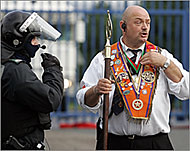
For a long time here on United Irelander I've spoken out against the Orange Order. If you don't believe me, just check my archives. In doing so I endured alot of flak from unionists who said my opinions about the OO were misguided and totally unfair.Well it gives me great pleasure right now to say to those people: I told ya so!
Yes it has been a miserable time for everybody's favourite bigoted Protestant organisation as they deal with long-standing Orangeman Rev Brian Kennaway's latest book, The Orange Order: A Tradition Betrayed, which includes shocking revelations about the Order and its nasty little relationship with loyalist paramilitaries.
The book claims that the Order has turned a blind eye to paramilitarism and violence in its own ranks and that sectarian murderers have escaped expulsion. As well as that it is claimed that sash-wearing members have openly attacked the security forces without redress.
Many of you may have also caught last night's Hearts and Minds programme on the BBC, which you can watch online here, where Rev Kennaway discussed his book's claims with a representative from the OO who squirmed uncomfortably throughout in the face of these damning allegations.
If all this wasn't bad enough for NI's rioters of the year 2005, David Trimble, himself an Orangeman, has come out accused elements within the Orange Order leadership of conspiring to damage the peace process.
Trimble, who last night was at a book launch for Rev Kennaway's book, said some unionists had entered a pact with elements in the Orange Order to try and wreck the Good Friday Agreement:
"They saw the Orange Order, Portadown District and the Drumcree issue as a battering ram that they would use to destroy the Agreement."
He added the Order had been manipulated:
"...with the intention of creating massive public disorder and violence so that it would have a political impact".
Shocking stuff. I've said it before and I'll say it again - the Orange Order is of no benefit to Irish society. It is an organisation that preaches exclusion and triumphalism and rather than bring communities together, it is primarily about keeping them apart.
The Orange Order is a disgrace and even its members seem to have finally acknowledged that much.
The real question now is - can the Orange Order ever recover from these claims?
Retired Colonel blasts 'fake republicanism'
Retired British Army Colonel Tim Collins, who achieved international fame for a speech he made to British soldiers hours before the invasion of Iraq, spoke at a debate in Dublin last night in which he blasted 'fake republicanism' here in Ireland.Mr Collins said there was a huge opportunity for the Republic to extend the hand of friendship to the unionist community in the North but that there was a snake in the grass:
"It can only happen in the Republic of Ireland if you deal with the menace of counterfeit Irish republicanism conceived in the back streets of Belfast."
Mr Collins said he had been furious on a recent visit to the republican plot in Crossmaglen, south Armagh, to find an inscription to two IRA bombers:
"To two Irish patriots from Poblacht Na hÉireann".
"When I look at the stretched white limousines driving around the streets of Crossmaglen and the drug smugglers and the pornographers and the counterfeiters, how dare they besmirch the name of that organisation?
"It (counterfeiter republicanism) can only be confronted by a confident new Ireland enjoying an entire breadth of its complex historical path."
Mr Collins was speaking at a debate organised by the Philosophical Society in Trinity College on Ireland’s forgotten heroes and its debt to history.
Mr Collins paid tribute to the Irish soldiers from both sides of the border who had served in the first battalion of the Royal Irish Regiment in Iraq and he went on to say that the problem in the relationship between the two peoples on the island of Ireland had to be addressed first by the Irish Government:
"I cannot tell you of the lack of sophistication in the politics of Northern Ireland. It is so backward, it is almost beyond help. The hand of friendship needs to come from this direction."
Mr Collins is currently working on a television documentary about the Irish influence in the battle for control of north Africa in World War II.
I agree with Mr Collins when he says that "fake republicanism" is damaging the potential for a greater bond between North and South.
The Provisional IRA are not patriots in my eyes and the same goes for the majority of Irish people.
Despite that though, I disagree with Mr Collins that the hand of friendship needs to come from this direction. What more can the Irish government do? It was only this past week that the DUP agreed to sit on the British-Irish Inter-Parliamentary Body and the Ulster Unionists continue to boycott it totally! How can you shake hands with people who won't even extend their hand to you?
I'm also not sure Mr Collins is right when he says that the Irish government must deal with 'fake republicanism' in NI. How can they do that? The only way would be for Fianna Fáil to finally organise themselves in the North - a move I personally support.
Overall though I think Mr Collins made some good points and I find it most refreshing to see a former British Army Colonel who can appreciate the obvious differences that exist between the Irish republicans and patriots of the past and the so-called Republicans of this generation, whose central ideology seems to revolve around criminality and sectarianism.
There are groups in this island today who are disgrace to the noble tradition of Irish republicanism.
On a personal note too, as someone who had a grandfather who fought with the Desert Rats in Africa in WW2, I look forward to Mr Collins' documentary on the Irish influence in the battles in north Africa during the war.
Dolly Parton & Hulk Hogan = Fun
With that being the case, I hereby present to you all for your viewing pleasure...the Dolly Parton song "Starlight, Starbright" featuring the one and only Hulk Hogan. Enjoy.
6 ways to get the woman you want

Men of the world rejoice! A series of studies across America by a team from North Adams State College in Massachusetts has lead to the development of a six-step plan for lonely guys and gals to land themselves a partner.According to The Sun (and they're never wrong) it's a "foolproof plan" that "could help thousands of lonely Brits hook up with a partner."
OK I'm sure you're all dying to find out what the steps are. Well, without further ado:
1. Ply the man or woman of your dreams with dark chocolate - It is packed with phenylethylamine chemicals, which induce feelings of excitement conducive to falling in love.
2. Take your targeted sweetheart on a rollercoaster - The exhilarating ride creates an adrenaline rush, which makes people find the opposite sex more attractive.
3. Strike up a conversation and pepper it with jokes - Laughing boosts brain hormones called endorphins, which give you a feelgood factor.
4. Maintain eye contact for as long as possible - Holding a person’s gaze affects the area of the brain linked to rewards, making them feel appreciated.
5. Stand with your arms down by your sides - It makes others feel an affinity with you.
6. Put soft rock music on the stereo - This works especially for fellas, as girls find them more handsome when they hear easy-going rock in the background.
Seems simple enough. I wish I had this information years ago! Basically all you do is buy a lady some dark chocolate, I'm thinking Bourneville, and then you ask her to go on a rollercoaster with you. I'm not sure how exactly you achieve that in this country but I'm sure there's a way. Next you try and make her laugh - which could very well happen when she hears you explain why you wanted her to go on a rollercoaster so bad - and then it's case of heavy eye contact and straight arms. By that stage she'll be putty in your hands so you finish her off by whipping out your stereo and your irresistible soft rock tunes. Simon and Garfunkel anyone?
And they say romance is dead...
Land of complaints and Scolari
I've been quite surprised at the fuss the English are making over what nationality their next manager should be.It has recently emerged that Football Association chief executive Brian Barwick has been in Portugal discussing terms with Luiz Felipe Scolari (pictured left) whose contract with the Portguese national team ends after the World Cup.
Scolari's pedigree as a coach is excellent. In 2002 he led Brazil to victory in the World Cup in Korea and Japan and in 2004, he led Portugal to the Euro 2004 final where they were just beaten by Greece.
He is also known for taking a tough stance with big stars and famously substituted Portugal star Luis Figo during the Euro 2004 tournament when he was underperforming against England - a move that helped Portugal advance in the tournament. In contrast current England coach Sven Goran-Eriksson has been accused of favouring certain players such as David Beckham.
Despite Scolari's impressive CV however, the English aren't happy with many leading figures in the game bemoaning the prospect of another foreigner in charge:
"No matter how brilliant a coach someone from abroad may be, it is a betrayal of Englishmen and England fans.
"We want an English manager that we can relate to. We all support the England team and part of that is an English manager. I expect the players and the manager to be English." - Birmingham chairman David Gold
"I said from the outset that in my opinion it should go to an Englishman.
"I am not going to change that opinion but if he does get the job then I am sure that all of us working at this level will get behind him." - Birmingham manager Steve Bruce
"For my money it's another blow to British coaching." - Mark Hughes (who is actually Welsh)
"I have done my pro license like Sam Allardyce, Alan Curbishley and Steve McClaren.
"We paid £7,000 to do them and then when it comes to the top job none of the English lads get it, which I find really disappointing." - Peter Reid
"I would like to have seen one of the England lads get it.
"There are some great young managers in this country who could do the job no problem." - Portsmouth manager Harry Redknapp.
England legend Tom Finney weighed in too:
"I would personally like to see Martin O'Neill appointed.
"I'm quite surprised there could be another foreign manager after Eriksson.
"It's sad to see they've gone abroad for a manager when England taught the rest of the world how to play the game."
Martin O'Neill himself of course is foreign being an Irishman, but I digress. The above comments display how English people are allowing blind patriotism take precedence over a proven winner.

Why do these people whinge so much?
The way I see it the English would be very lucky to get Mr Scolari as their manager. The nationality of the man is irrelevant. You get the best man for the job and right now none of the English contenders have anywhere near the level of experience that Scolari possesses.
With that being said, I can't imagine why any man would want to take on this job anyway as it means having your private life left to the mercy of perhaps the most vicious media in Europe, if not the world! Add to that the fan expectation which is always sky high and it makes for a head-wrecking job altogether. I wouldn't take the job regardless of how much money they threw at me.
It will be interesting to see if Scolari does accept the offer and what the English reaction will be if that happens.
Update: Scolari has turned down the opportunity. Can't say I blame him.
Separated at Birth?

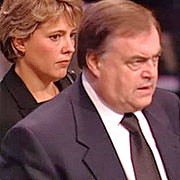
One is a powerful old geezer still doing well with the ladies, the other is Hugh Hefner.
Playboy owner Hugh Hefner and British Deputy Prime Minister John Prescott - separated at birth? You decide.
Friday Fun's Fascinating Fact
I suppose as long as there's no honeymoon...
Thursday, April 27, 2006
Thursday Thoughts: 'Northern Irishness'
"You can no more split Ireland into two parts than you can split England or Scotland into parts. Ireland is a nation; not two nations, but one nation."British PM Herbert Asquith, speaking in 1912.
Hugh over at Most Sincerely Folks wrote an interesting post on the issue of 'Northern Irishness' and how he suspects there really is no such thing. Long-term readers of this site will know that I take the same view and Hugh drew my attention to the fact that United Irelander actually tops Google's 200 search results for "Northern Irishness".
The essence of Hugh's argument was the same as my previous arguments - if there is a 'Northern Irish' nationality then ergo there must be a 'Northern Irish' nation. As we all know however, there is not.
'Northern Irishness' is a lie. People who describe themselves as 'Northern Irish' are the equivalent of football supporters who call themselves ABUs (Anybody But United). They cling to this 'Northern Irishness' because they oppose 'Irishness' due to its connotations. They have basically allowed others to dictate to them what Irishness must mean and so they run to the sanctuary of their false 'Northern Irish' nationality which, if pressed, they would be unable to define.
For instance, what are the colours of this 'Northern Irishness'? If you ask an Irishman to describe the colours of Irishness he will most likely reply green, white and orange. Ask a Briton and the likely reply will be red, white and blue. Ask someone who feels Northern Irish the same question and what reply will you get? Will you even get an answer?
And what is the relationship between 'Northern Irishness' and Irishness and 'Northern Irishness' and Britishness? Can someone 'Northern Irish' even answer that?
The simple truth is that without a nation you cannot have a nationality. The Irish nationality stems from the Irish nation. The Irish nation is the 32-county entity that Herbert Asquith spoke of in 1912 when Ireland was part of the UK. That nation remains the same to this day. States may have been formed in that time such as the Republic of Ireland but the Irish nation remains the same regardless. The Irish nation is a product of the four provinces of Ireland. It is a product of centuries upon centuries of shared culture, history and politics. It is indestructible.
In contrast, 'Northern Irishness' is the product of a manipulated territory known as Northern Ireland which was designed to guarantee an unfair Unionist majority in 6 Ulster counties. An entity which Lloyd Gerge described as "a frontier based neither upon natural features nor broad geographical considerations." From this shady, dishonest foundation it is hardly surprising that the nationality of 'Northern Irishness' failed. Likewise, it's hardly surprising that Northern Ireland itself has been an abject failure. Its legacy is sectarianism, political misrule and murder. Why would anyone want a nationality out of such a place?
One has only to look at Northern Ireland today to see the lie that is 'Northern Irishness'. The flag for Northern Ireland is the Union Jack - the people in NI have no desire even for a flag to represent the region! As well as that none of the four main parties in the North describe themselves as 'Northern Irish'. Unsurprisingly, the nationalist parties regard themselves as simply Irish but even the unionist parties refuse to embrace 'Northern Irishness'. The DUP are unashamedly British and the UUP even went so far as to launch an astonishing campaign slogan called, "Simply British", where they not only showed their contempt for Irishness but 'Northern Irishness' as well! The two main nationalities in NI are still Irishness and Britishness.
Prior to Partition, unionists described themselves as Irish. Both Edward Carson and James Craig continued to regard themselves as Irish. If you go back further through time, you'll find Protestant movements like the Patriots who took an active interest in Gaelic culture as well as Ulster Protestant involvement in the Irish volunteers who along with Grattan sought an Irish parliament. Radical Presbyterians even sought to dismantle all ties with England and establish an Irish republic.

The orange is a part of us too
When you look at it objectively, unionist hostility to Irishness means unionists have allowed themselves to be dictated to on what nationality they can and cannot identify with. Up until The Troubles in the North, many unionists continued to call themselves Irish yet when the Provo's campaign stepped up a gear, a campaign most Irish people did not support, unionists allowed themselves to be bullied by it.
The Provos might not have bombed unionists out of the UK, but to a large degree they bombed unionists out of their identity.
I personally look forward to the day when the island of Ireland is reunited once more. When several nationalities will live together in a 32 county nation-state. Where we will see Irish, Polish-Irish, Chinese-Irish, Nigerian-Irish and of course British-Irish living and working together in harmony.
"No surrender" went the unionist cry during The Troubles yet many of these unionists went on to surrender their Irishness. Sticking the word 'Northern' in front of the word 'Irishness' doesn't alter that fact.
Irishness is indeterminate. No one can deny unionists their rightful place in this nation. These days, no one will. Just ask the immigrants that continue to make Ireland their home.
This country is for unionists too. They should never forget that and I personally hope that, one day soon, they'll realise that.
"My...words to my...country-men are these: It has always been a pride to a man, no matter what part of the country he came from, to say he was an Irishman." - James Craig
Wednesday, April 26, 2006
Words on Wednesday...with Ambassador Sobkow
Welcome to this week's Words on Wednesday feature here on United Irelander, a concept unique to the Irish blogosphere, which sees me interview various figures from all walks of political life.Taking my questions this week I'm pleased to say is the Polish Ambassador to Ireland Witold Sobkow.
I'd like to thank Ambassador Sobkow for very kindly agreeing to be interviewed. With that being said, let's begin.
What initially attracted you to political life?
I am not a politician. I am a civil servant. Before the democratic changes in Poland in 1989, I had not wanted to work for the Ministry of Foreign Affairs. I was a lecturer at Warsaw University, as it was a free profession, enabling me to do what I wanted to do, without having to be a member of the Communist Party. After 1989 new opportunities turned up and I could enter for an open competition in autumn 1990 to become an employee of the Ministry of Foreign Affairs. I managed to pass the examinations and in March 1991 I became a desk officer responsible for Italy, Malta and the Vatican. Then I was promoted to the post of Head of Section, and afterwards to the post of Deputy Director. I am a career diplomat, not a political nominee.
You are the Polish Ambassador to Ireland. Talk us through a typical day in your life.
A typical day in my life is work, work, and work, as I consider myself a workaholic. I spend most of my time in the office, I attend conferences, various seminars, I have lectures all over Ireland, I see Irish politicians, civil servants, businessmen, scientists, academics and students to explain Poland's official position on matters that interest them, or to try to broaden co-operation between Poland and Ireland. I often write letters or articles that are later published in different Irish newspapers, I give TV and radio interviews or answer different queries. As far as my free time is concerned, I usually listen to music or watch DVDs. Since I have a little daughter, I try to spend with her as much time as possible.
If you could change three things about Irish society, what would you change and why?
Ireland is a very friendly, hospitable country. Poles here feel at home. I would not change much. What I do not like, probably like most of the Irish, are high prices, much higher than in Poland. I do not complain, however, about the weather. My impression is that it is only the Irish that complain about the weather - foreigners are happy with your variety of sunshine, storms, rain, and wind. I look forward to the end of the construction of the Port Tunnel, as it would save us a lot of time to reach the airport.
There are estimated to be over 100,000 Polish people living in Ireland, mostly in Dublin. What are their thoughts on Irish society?
Poles see a lot of similarities between Ireland and Poland. We are both Catholic countries, with similar history of oppression and semi-sovereignty, with a tradition of emigration. We have a similar sense of humour. We work hard, but we are able to have a good time.
Many European countries seem to have had problems with integrating minorities. Not too long ago in France for example there were race riots and this has occurred in Britain too, however Ireland hasn't had these kinds of problems. Why do you think that is?
Ireland has no huge problems with immigration because of many factors. In France, for instance, you have a sizeable marginalised Muslim community, which is a legacy of France's colonial past. Ireland has no colonial past. For Ireland immigration is a relatively new phenomenon. For France, Britain or Germany it isn't. Ireland is pragmatic and presents an attitude worthy of praise: "if you have a problem, solve it constructively". One example of such a positive attitude is a decision to give up the requirement of knowing the Irish language for Garda recruits - as a result more than 200 immigrants are being trained to serve the Irish and their national communities - this is a step towards a better integration. There are Polish shops, churches, school, and cultural centres in Dublin. We feel at home.
Not many Irish people would be familiar with how they are perceived in Poland. In Poland, how is Ireland viewed?
People in Poland love Ireland. It is a symbol of friendliness and European success. It is a hospitable and beautiful Emerald Island. People love Irish music, dancing, Guinness and whisky. We have Irish pubs in Poland, we celebrate St. Patrick's Day. A few folk music groups play Irish music. A lot of Irish trade and investment companies thrive in Poland. The Irish investment has exceeded 1 bln euro. Irish farmers lease land in Poland. There are a lot of mixed marriages. It's almost always a Polish girl and an Irish boy.
Ireland has done very well economically from the European Union. Poland of course joined the EU in 2004. What does Poland hope to achieve from its membership of the EU?
We hope to achieve from our membership of the EU exactly the same as in the case of Ireland. Ireland had hoped for positive changes when it joined the EEC in 1973. We had the same expectations in May 2004. Our membership is about prosperity, belonging to the same Western club of nations sharing identical values based on democracy. It enables us to have more influence on global affairs, our voice is heard better. Our membership lets us realise Poland's strategic aims, broaden co-operation in economic, political and cultural matters, use the benefits of the single market, develop faster. We have rights, but we also have responsibilities; we agree to pool a part of our national sovereignty. Our farming industry needs to modernise; our roads need to have higher standards. EU funds help us create a more modern Poland.
Ireland is very much influenced by its history and recent polls suggested that the majority of Irish people still favour a United Ireland. Would the Polish people coming into Ireland have much knowledge about this issue?
People coming to Ireland know little about history of Ireland. They have only basic knowledge. They know basic facts about the peace process, IRA, religious, political and social differences in the North, but it is very difficult for a foreigner to understand such a complicated matter. We are happy that the Good Friday Agreement has led people in the whole island to eliminate violence and to develop peacefully, in the spirit of understanding and solidarity.
In the future, Irish society is going to be made up of Polish-Irish, Chinese-Irish, Nigerian-Irish etc. How do you think this will affect Ireland?
Immigration affects each country. For example, in Poland we have a Vietnamese community. They have their restaurants, shops, places of worship. They are treated very well, as friends. We have refugees, too - from Chechenia, Ethiopia, Somalia, etc. Those people enrich our culture. If they work, they contribute to the wealth of our country. We respect them and embrace their diversity. We try to do our best to eliminate any signs of intolerance, racism and xenophobia.
A Polish figure who was very respected in Ireland was Pope John Paul II. How are Polish people viewing his successor, Pope Benedict XVI?
Pope Benedict XVI is widely respected and liked. He will visit Poland in May. It will be a special event for us. Cardinal Ratzinger was one of the closest friends of John Paul II and his valuable advisor. When you see TV pictures from the Vatican, a majority of visitors waving their national flags is still from Poland.
Recently the Irish State celebrated the 1916 Rising. What are your own thoughts on that?
We admired the events to commemorate Easter Uprising. For us it was a beautiful ceremony and an opportunity to deepen our knowledge about what happened in 1916. We look forward to the 100-th anniversary. We are happy those were peaceful and dignified events, so important in the endeavours to reach a lasting peace in the whole island.
What are your thoughts on the conflict in Iraq?
Iraq is a complex matter. Most people in Poland would rather see Polish troops withdraw from Iraq this year. Our decision to join the coalition forces was a difficult political decision, but we think that Poland, a member of Nato and the EU, needs to contribute to fighting oppression in different parts of the world. When we were under the communist rule, Solidarity Movement in Poland tried to make Poland a free, sovereign, and democratic country. We had a lot of assistance from abroad, from democratic peoples of the West. Iraq was the place where we thought it would be wise to help the oppressed people to remove Saddam Hussein, known for his atrocities. It was not just a threat of weapons of mass destruction that made us act. We look forward to seeing a prosperous, secure, sovereign Iraq, ruled by the Iraqis.
Ireland is known for its strong friendships with countries like the USA and Australia. Do you think one day Ireland and Poland will become just as close?
Ireland and the USA or Australia are very close for many reasons. The main factors are huge waves of Irish emigrants and the use of the same language. Poland and Ireland are slightly different in this respect, but our relations are excellent. They will develop further as we share a lot, and there are no serious disputes or differences between our countries. Polish immigration in Ireland makes our countries even closer. We are only different in our attitude towards defence, as Poland is a member of Nato. Poland and Ireland, being active partners in the EU, share a special bond with the USA.
Finally, I'd like to play a small round of word association. I'm sure you know what it entails. Basically just outline what word comes into your head when you hear the following names:
Bertie Ahern - excellent mediator; Westlife and successful novels (U know why)
Mary McAleese - Phoenix Park, fantastic woman, pride for Ireland, elegance
George W. Bush - Iraq, 9/11
Lech Walesa - Solidarity, moustache, Black Madonna
Witold Sobkow - .....
Next week, Irish Senator and former President of the Irish Congress of Trade Unions Joe O'Toole takes my questions. Be sure to keep clicking in to United Irelander for a firsthand look at Irish political life.
Tuesday, April 25, 2006
Top Ten Tuesday - Political issues
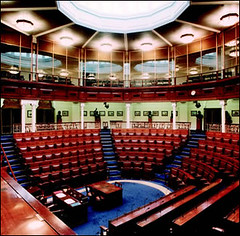
I commented below on Fine Gael's plans that they hope will see them get into government once again.Fine Gael's strategy is part of an initiative they are calling "Ireland Deserves Better". As campaign slogans go, it's pretty lame. The main themes of their campaign however will be health, crime and the waste of public money.
With that being said, I got to thinking about some of the issues I feel strongly about and would like to see progress on, and pretty soon, a list formed in my head.
So without further ado I give to give you all the top ten political issues I want to see tackled:
1. The North - I remember Bertie Ahern saying that for a Taoiseach, NI is probably the most important issue to be dealt with. I would agree with that. When you take into account too the recent Sunday Business post poll which found a majority in favour of a United Ireland and 22% believing achieiving this should be the Government's top priority, it's clear NI remains a very important issue here in the South.
2. Health - I've commented many times on the lousy job this Government has done in relation to health matters. See here and here. If parties can come forward an offer sound solutions to sorting out the current problems, myself and the rest of the Irish public will be all ears.
3. Crime - Crime has been a big problem for this government and question marks have been raised about the Justice Minister's handling of the situation. Remember the recent spate of gang killings? I want these people caught! Crime does seem to be getting worse by the week in this country.
4. Road deaths - Readers will know about my feelings on this issue. I don't feel enough is being done to stop the rising number of people killed on our roads.
5. The economy - Fianna Fáil would argue that Ireland has done well economically but what about the cost of living here? Remember 'Rip-off Ireland'? If other parties can offer reasons how they could do better I will hear them out.
6. Education - This is another important issue and recent news that disruptive behaviour in secondary schools is at "crisis point" is a real concern.
7. Yob behaviour - I wouldn't put this in the same bracket as crime because when I refer to yob behaviour I'm talking about the typical bad rabble you see hanging around corners at night. They are a menacing presence for communities, particularly to the elderly, and if solutions can be offered to deal with them I will again be very interested in hearing about them.
8. Drugs - This might be related to the above point. Drugs are as problematic now as they have ever been yet I think more could and should be done.
9. European Union - I am very wary of the EU and I wish more parties would stop entrusting so much faith in that lousy shower from Brussels. The EU Constitution remains a concern of mine.
10. Irish language - I'd like to see some sound proposals for helping the Irish language. My own view is that Irish ought to remain a required subject at Leaving Cert.
So there you have it. The top ten political issues I'd like to see tackled by political parties. Whichever party deals with them the best will get my vote. Feel free to comment on my choices or to offer up some of your own.
Power-sharing in our interest - DUP
The big news so far from Killarney, County Kerry, where the British-Irish Inter-Parliamentary Body have been meeting, relates to comments made by DUP deputy leader Peter Robinson who has stated his party will consult the entire unionist community if and when, in its opinion, the IRA has moved from violence to democracy. Speaking to the Body, Mr Robinson said:
"I cannot say if or when a judgement can be made that completion has been reached, but if and when a prima facia case can be made, we have committed ourselves as a party, in our election manifesto, to a consultation process within our community."
Seems fair enough but then Mr Robinson began to stretch the truth somewhat saying his party had "nothing to gain by unnecessarily delaying devolution":
"With over 30 MLAs, we are the largest political party in Northern Ireland and would have greater influence than any other party over decisions taken in the province.
"It is in our interests, and more importantly, it is in the interests of the people we represent, that when the conditions are right we have devolution returned to Northern Ireland at the earliest opportunity."
I think Mr Robinson ought to inform many of the unionists in his own party about that because as I highlighted in this post back in February, alot of these people take a different line. In a survey of 100 delegates who had attended the DUP's annual conference in Belfast, 37% of those questioned felt that felt that even if the IRA ended its criminality and destroyed every weapon, direct rule by British ministers in the North would be preferable while 24% had no opinion. Even though 39% of those questioned believed that, in the right context, the party should share power with Sinn Féin and other parties, those figures are still very worrying.
I see some have viewed Peter Robinson's comments as a 'Get Out of Stalemate Free Card'. It remains to be seen if that will be the case.
My own view is that the two government's recent proposals for restoring devolution have got the DUP quite flustered. I believe the top brass in the DUP like Robinson do want to be power but that this is being made difficult by those who are quietly pleased with the status quo. Thus I think that the real "consultation process" will not be through external talks with other unionist figures, but rather through an internal consultation process with their own hardline, devolution-wary members.
We can only speculate at this point how this process will unfold.
Does Fine Gael deserve Ireland?
I see Fine Gael yesterday launched a campaign on the issues they believe could lead them to success in next year’s General Election. I figured I'd give my thoughts on their proposals.
Health, crime and the waste of public money will be the themes of posters and billboards appearing around the country in the next six weeks as part of a Fine Gael initiative termed "Ireland Deserves Better".
Commenting on the plans which he will outline at the Fine Gael Ard Fheis on May 5 and 6, party leader Enda Kenny said:
"Ireland deserves better than rising crime and falling detection rates. It also deserves a Government that uses the taxpayers’ money wisely and well. And, most certainly it deserves better than a health system that regularly sees hundreds of people stranded on hospital trolleys for days on end.
"On foot of repeated comments at public meetings and constituency clinics about these issues we have put together a campaign."

Vote for me, you know you want to...
Mr Kenny outlined that the first phase of the campaign identifies real fears, frustrations and grievances that taxpayers face while the second phase of the campaign will include a national series of public meetings centring on the solutions offered by Fine Gael. He added that the final phase of the campaign will run from the end of May into June and will involve more public meetings and a summary of their proposals for up to 500,000 households.
Hmm. As someone who is quite sympathetic to the idea of a change of government, I must say I'm not terribly impressed with this plan by Fine Gael. I feel this campaign is somewhat of a microcosm of the party in general - too much emphasis on detail and not enough action.
For example, let's look at the lethargic campaign slogan: "Ireland deserves better". Gee, really? How insightful! What a groundbreaking idea it is for a party in opposition to claim that the country could actually be in better shape. My stars!
Then we have this 'phase one' guff about how Fine Gael understand the problems of Irish society etc. Yeah well, so do we! Give us your solutions from the off and repeat them all the way to the Ard Fheis and beyond.
I'm someone who would consider voting for Fine Gael but I don't know what their solutions are for the country. I'm aware that they want to change the status quo so I don't need to hear about that. Focus on the main points - the ineptitude of the current administration.
We have a government that is presiding over an absolutely shambolic health service with people stuck on trolleys instead of hospital beds and we have had criminal gangs come to the forefront of Irish society in the last few months. Tackle Bertie's boys on these matters for goodness' sake. Take the gloves off and give them a hammering.
Right now there are real question marks over whether Fine Gael can be trusted in power. After all, it's easier to criticise and point out flaws than it is to correct them so if Mr Kenny can't do the former, how can we be sure he can do the latter?
This country is crying out for an alternative. Fine Gael don't need to tell us they understand that, they need to instead start concentrating on providing that alternative.
"Ireland deserves better", goes the Fine Gael cry but the real question is, does Fine Gael deserve Ireland?
Monday, April 24, 2006
Love Thy Neighbour
"And the second is like this, thou shalt love thy neighbor as thyself. There is none other commandment greater than these." - Mark 12:31I was saddened to hear that a Protestant man has been left with serious facial injuries after an attack in Derry.
The attack has been condemned by the city's Sinn Féin mayor
Lynn Fleming.
Chief Inspector Ken Finney said the man had "received a very serious beating":
"When the police went to speak to him, they had to do it by pen and paper because he couldn't talk.
"I would hope that this can be nipped in the bud in an early stage, and the communities can calm themselves down."
Michelle Hayden, from the Irish Street Community Association, said she was concerned about the atmosphere:
"Tensions have increased from the attack."
"I think it was the seriousness of the attack that has been reported back on the ground that has heightened tensions."
She said she thought this had probably brought "run of the mill" interface violence in at "an earlier aspect than we would have in the month of April".
A friend of the injured man was also hurt in a separate attack, though not seriously. There have been ongoing problems in the Waterside area. A Catholic family recently said they were leaving their Heron Way home due to the tensions.
Shame on these thugs who are damaging community relations through their pathetic sectarianism. As if this wasn't depressing enough, the Belfast Telegraph reports that a cross-community deal which saw the removal of a UDA mural overlooking Harryville Catholic Church, which I praised here back at the start of April, is now in ruins after a war of words erupted between loyalists and republicans. (Hat tip Slugger)
Loyalists issued a statement saying the deal was off because republican flags were still in place and officials said the UDA mural could go back up in place of an Ulster Scots mural which was unveiled a few weeks ago.

Old mural could be restored
I think both parties in this mural dispute should take a long hard look at themselves. The Republicans have reneged on their word for which they should be condemned but the Loyalist threat to restore the mural is ridiculously petty.
All in all this is a pretty depressing day for community relations in the North!
"How good and pleasant it is when brothers live together in unity!" - Psalm 133
Monday Madness - Jailing of Irish illegals
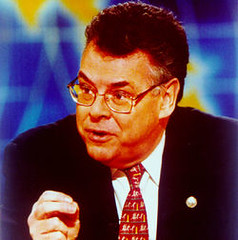
I was disgusted to learn courtesy of the Irish Independent that Peter King, a Right-wing US Republican Congressman and Sinn Féin President Gerry Adams's main political ally in the United States, has backed anti-immigration legislation which could force up to 50,000 illegal Irish workers to flee the country or face jail.The move has outraged the Irish-American community as the Bill could make it a crime to be an illegal alien and a rift has opened up between Irish-Americans and King.
King has even denounced Catholic bishops who oppose the legislation which would make up to 12 million illegal immigrants instant felons and also make it an offence punishable by five years' imprisonment for anyone who harbours or employs an illegal alien. The church has declared that the new law would make a felon out of a priest who counselled an illegal alien.
A group has been set up called the Irish Lobby for Immigration Reform whose spokesman, ironically, is another long-time friend and ally of Adams, Niall O'Dowd. O'Dowd and King are now at odds over the proposed legislation which would force undocumented Irish to return home or face imprisonment.
The Irish Lobby, which is supported by the Irish Government, organised a protest at Washington to coincide with the St Patrick's Day celebrations.
It has strong support within the Irish-American resident community, particularly in the Tri-State area and has attracted the support of powerful US politicians including Senators Ted Kennedy, Hillary Clinton and John McCain all of whom support amending legislation which would allow illegal immigrants "guest worker" status and eventually citizenship so long as they pay back-taxes on income they have earned since being illegally in the United States.
Peter King however is opposed to this proposal.
What a disgrace! It seems Mr King is good at paying lip-service to the Irish but when it comes to helping them out, he doesn't want to know! Have Americans forgotten what Irish people have done for their country? I have a book called "The Irish Americans" by Ernest Wood which Americans like Peter king should take a look at as it explains the influence the Irish have had on the USA. For example:
- Among the signatories of the Declaration of Independence were four native Irishmen and four men born of Irish parents.
- An Irishman, Patrick Carr, was one of the five people killed in the Boston Massacre.
- "Give me liberty or give me death!" was part of a famous speech by Patrick Henry to the Virginia Assembly in 1775. Henry was a Virginian of Irish descent.
- John Barry, a native of Ireland, was the first American naval commander to capture a British warship during the Revolution. Later, Barry became the first commander of the US Navy and is today regarded as "Father of the American Navy".
- During the Revolution, 38% of the American forces were Irish. Wrote a British officer of the Americans, "The rebels are chiefly composed of Irish redemptioners and convicts, the most audacious rascals existing".
- The Irish joined public-service jobs in America and many became firefighters and policemen. By the time of the Civil War, New York's police force was 28% Irish, despite accounting for only 16% of the city's population. They filled police forces from Boston to New Orleans to San Francisco.
- The Irish were not well received by all Americans. There were "No Irish need apply" signs, Protestant maids were preferred to Catholic maids, and in the 1850s, the "Know-Nothing Party - which advocatd "America for Americans" - urged physical violence against the Irish. Riots broke out in Philadelphia, Newark, Baltimore, Brooklyn, St. Louis and several Massachusetts cities. In Louisville, riots occurred against both Germans and Irish, with fires and looting of stores and houses until many immigrants left the city. This hostility took years to die out and the Ku Klux Klan added anti-Catholic sentiment to its anti-black sentiment. A cartoon from the early 20th century in Life magazine depicts hooded Klansmen staring down the Irish and blacks in Atlanta on St Patrick's Day.
- Despite this hostility, 144,000 Irishmen fought for the Union in the US Civil War, a smaller number for the Confederacy. The Irish 9th and 28th of Massachusetts both carried green flags, one with the inscription: "As aliens and strangers thou didst us befriend. As sons and true patriots we do thee defend."
- John P. Holland emigrated to America, where he built the first successful submarine. In 1900, he provided the US Navy with the first operational submarine, the U.S.S. Holland.
- Henry Ford, whose father fled the Irish potato famine in the 1840s, created one of the largest automobile companies in the world.
- America's most decorated World War 2 servicemen, Audie Murphy, was the son of a Texas-Irish sharecropper. He won 28 American and foreign medals, including the Congressional Medal of Honor, and singlehandedly held off a German force of more than 200 men and half a dozen tanks. After the war he starred in many films including his own story, To Hell and Back (1955).
- While in the 19th century the Irish were shown in American theatres as bumbling, belligerent and drunken buffoons, in the 20th century the Irish began to make an impact on the US screen through people like Grace Kelly, Maureen O'Hara, Scarlett O'Hara, Gene Kelly, James Cagney, Bing Crosby and John Wayne.
- US President John F. Kennedy was very proud of his Irish roots. He famously commented, "I know that the White House was designed by James Hoban, a noted Irish-American architect, and I have no doubt that he believed by incorporating several features of the Dublin style he would make it more homelike for any president of Irish descent. It was a long wait, but I appreciate his efforts."
When you consider the above information is it really too much to ask for the American people to show some respect to the Irish that now live there in the States? Americans like Niall O'Dowd, Ted Kennedy, Hilary Clinton and John McCain appear to appreciate the efforts of the Irish so why can't Peter King?
Do Americans like Peter King not give a damn about what the Irish have done for their country?
Shameful.
DUP coming to Kerry!
I see the beautiful county of Kerry is set to get some unusual visitors today - a delegation from the Democratic Unionist Party!Yes the British-Irish Inter-Parliamentary Body (BIIPB) convenes today in Co Kerry and will be chaired by former NI Secretary of State Paul Murphy.
The BIIPB was established in 1990 as a link between the Irish and British governments.
It originally comprised 25 Irish and 25 British members drawn from the upper and lower houses of both parliaments. In recent years the membership of the body has been extended, to include representatives from the Welsh Assembly, the Scottish Parliament, the North's Assembly – when convened – and the Isle of Man and Channel Islands.
The DUP will be making their first ever attendance and their delegation will be led by deputy leader Peter Robinson and includes fellow MPs Iris Robinson, Nigel Dodds and Jeffrey Donaldson.
The DUP will not be taking its seats on the body, but will make a presentation. The UUP on the other hand continues to boycott the body.
The Taoiseach Bertie Ahern has hailed the move as significant:
"For many years we wanted to see unionist involvement."
"The fact that we’re about to see that should be seen as very significant."
Paul Murphy has also welcomed the move:
"It is very important. It has shown how barriers have broken down in recent years.
I’m delighted that members can listen to their presentation and ask them questions afterwards."
The Welsh politician said he expects goodwill to be shown towards the unionist party at the BIIPB:
"It will be a very significant day in British-Irish relations and in the way in which the body operates."
Mr Murphy however refused to speculate on whether the DUP would agree to join the BIIPB in the near future:
"When they come and talk to us they will make their minds up. It’s a first step."
I likewise welcome the move but isn't it so silly of the unionist politicians to refuse to take seats on the body? I'd be interested in hearing what any unionist readers have to say about that.
I feel it highlights the fragility of political beliefs held by unionists. I mean, why are they so afraid of engaging in dialogue with Irish politicians? Anyone?
With that being said, at least the DUP are making an effort which is more than can be said of the UUP. I'll give Paisley's party credit for that at least.
The unionists really should put aside their reservations about this body though and join it. After all, what have they got to lose?
Update: They have decided to consult the unionist grassroots in future before deciding on power-sharing. I'll post more on this later.
Caption Time
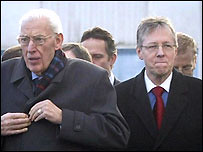
It's been a while since I've done one of these!Can you add a caption to this image to your left? (My effort can be seen by rolling over the image)
North's politicians unite to battle bigotry

I was pleased to learn that nationalist and unionist politicians in NI, among them the SDLP's Sean Farren (pictured left), are to travel to Scotland to learn how First Minister Jack McConnell's administration is tackling religious and racial bigotry.SDLP Assembly member Sean Farren confirmed a plan for members of his party to team up with the Ulster Unionists in a campaign to tackle prejudice in Northern Ireland as his party hosted a conference on the issue in Belfast today.
The former Stormont Finance Minister said:
"Today's event which will have a contribution from Scottish Justice Minister Cathy Jamieson is designed to see what politicians on both sides of the divide can do to tackle sectarianism and racism.
"We very much believe that sectarianism and racism are two sides of the one coin.
"They are motivated by the same type of prejudices, ignorance and stereotyping.
"We are planning to work with the Ulster Unionists to tackle this problem and we are planning a visit in the near future to Scotland to learn from their experiences in tackling racism and religious bigotry in their part of the world.
"We are also talking about another event in the autumn involving the SDLP and Ulster Unionists."
This is welcome news. Sectarianism is a problem that needs to be tackled and this can only be achieved by the parties in NI uniting together to condemn it. You will remember I interviewed Sean Farren back in March, which you can read here, and when I asked him if he could change three things about Irish society what would he change, the first thing he said was:
"There is one thing above all others that I would want to change, indeed want to eliminate. It is sectarianism. Sectarian attitudes are very deepset and these exist South as well as North and act as a poison in our relationships. Politicians have a serious obligation to work towards their elimination. These attitudes are not the preserve of any one social class, one religious denomination or one political party but are to found throughout our society. Since sectarianism is another version of racism it shares all the characteristics of that disease."
It would seem Mr Farren does have a sincere desire to rid society of sectarianism and for that I commend him as well as the Ulster Unionists.
NI gets its first hardcore porn site
Mr Dowey has promised that, in coming weeks, he will have an entire section devoted to local girls involved in raunchy XXX-rated action:
"At the moment, we're screening mainly American and British porn movies, but from next month we'll be offering high-quality hardcore action featuring local girls."
The site will also offer DVDs, live chatrooms and adverts offering a range of sexual services. Dowey, 50, said the introduction of the Human Rights Act had opened the door for him to produce porn:
"Everything has changed and there are now no barriers to full-blown adult pornography.
"I've been filming for almost a year in hotels and beauty spots everywhere from Coleraine to Cork. (Since when is Cork a beauty spot?)
"The girls we'll be featuring are absolutely stunning.
"There is partner sex, wife-swapping, group sex and dogging all on camera.
"The idea that in Northern Ireland we're somehow backward or inhibited is nonsense - our girls and fellas were well up for it."
Hmm. Can't say I like the idea of the average couple from Coleraine and Cork engaging in this business. In the words of Father Ted, "Down with this sort of thing!"
Still, you can make your own minds up by viewing a clip from the site here.
Sunday, April 23, 2006
Sinn Féin in British Legion row
I was very disappointed to learn courtesy of the Belfast Telegraph that Sinn Féin councillors in Antrim have refused to lend their support to a motion designed to recognise the charitable contribution that the Royal British Legion has made to the area.Ex-Mayor Mervyn Rea, who officially tabled the motion, said he was "delighted" to put it before the chamber, adding that the Legion richly deserved the council's highest honour.
But Sinn Fein's Henry Cushinan refused to offer support.
He revealed that his party group would not be backing the motion - but his justification provoked howls of protest.
He suggested the decision to honour the Legion was overtly political, adding that it had come at a sensitive time for republicans:
"Let's not forget that there are two traditions in this borough.
"My tradition cannot support the Royal British Legion. My tradition have their own way of remembering their dead in their own way with the Easter Lily."
But former SDLP man Oran Keenan disagreed:
"I've no problem supporting the motion.
"I've travelled across England and visited various branches of the British Legion, and it's only in Northern Ireland that there is a problem between different traditions.
"It is a charitable organisation and it supports people of all colours and all creeds. We should show some respect."
This was echoed by SDLP councillor Thomas Burns, who agreed that they had done "some tremendous work over a long period of time".
Alliance leader David Ford welcomed the "broad acceptance" among members - but voiced disappointment that it was not unanimous:
"I regret that Councillor Cushinan and his colleagues cannot bring themselves to support this."
Mr Rea argued that the republican abstention flew in the face of the views held by former Sinn Fein representative Martin Meehan.
He told the chamber that the former IRA man had told him that he was keen to visit the battlefields of the Somme to visit the grave of his grandfather - an ambition he later fulfilled:
"Here was someone from the other side, someone who was fairly bitter, who recognised that both sides fought and lost," said the UUP man.
The conferment ceremony is set to take place on June 24.
My my, what a stupid and immature stance Mr Cushinan and his party have taken! What's this nonsense about "My tradition does this..." and "My tradition does that..."? Apparently Sinn Féin want a United Ireland yet they are coming out with divisive crap like this?
Last week in Dublin the Irish people paid tribute not only to the Easter rebels who died during the Easter Rising but also to British soldiers as well as civilians. We showed that we can all honour the dead in a mature and fair fashion. Sinn Féin would do well to reflect on that and learn from it.
At least the SDLP showed a bit of cop-on but idiotic stuff like this from Sinn Féin just leaves me scratching my head and according to Mr Rea, the former Sinn Féin representative Martin Meehan had actually made an effort to take the other tradition into account which just makes this even worse!
For crying out loud if the British Legion have been doing good work then honour them and get over this narrow-minded anti-British baloney.
If Sinn Féin want to be "king makers" here in the South in the words of Michael McDowell, then they ought to cut out this kind of nonsense because down here, BS like this isn't going to do them any favours.
Saturday, April 22, 2006
Oh lord...I mean Judge
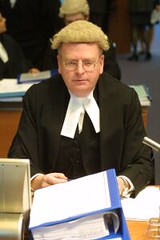
I see Justice Minister Michael McDowell (pictured left wearing his Dolly Parton wig) has decided to deal with the British legal traditions which are still in evidence in Irish courts to this day.As the Irish Independent reports:
"From next week, judges will be called exactly what they are - judges.
"Long-accepted, but antiquated, forms of address including "Yes, my lord", "No, my lord" and "lordship" are set to be replaced with far more simple replies like "Yes, judge"."
On Thursday Mr McDowell announced that the official mode of legalspeak used when addressing the Supreme Court and High Court's superiors is to be consigned to history. The new mode of addressing judges will come into effect from next Tuesday.
The minister emphasised that he was doing his bit for the Republican state in light of the recent Easter celebrations:
"I think it is appropriate that, under a republican constitution, the old-fashioned mode of address has been ended."
Alot of you may be wondering why it's taken so long for this to happen and why the Irish State didn't change things straight away after independence. Well, as this article in the Sunday Times reveals, efforts were made but they never really came to much:
"Since the 1150s, when Henry II introduced the common law system empowering judges to dispense justice on behalf of the king, commoners have been required to treat them as nobles, and deploy a host of titles such as "my lord".
"Despite attempts to abolish the practice in Ireland after independence in 1922, it has clung on. In fact, the new rule has existed since 1961 but the Irish courts refused to adopt it in practice. This was despite the fact that Article 40 of the Irish constitution says "titles of nobility shall not be conferred by the state" and no title of nobility or honour may be accepted by any citizen.
"Upon his appointment in 1924 the first Irish chief justice, Hugh Kennedy, asked the Dail to scrap judges’ titles, but the request was refused. Kennedy also proposed new designs of wigs and gowns for the judiciary but they were also turned down.
"In 1961, when the Dail finally established the court system, the law stated that judges were to be addressed simply by their title and name, yet the honorifics persisted.
"In the 1980s, the appointment of the late Justice Mella Carroll as the first female High Court judge prompted widespread confusion among barristers as to whether to refer to her as "your ladyship" or "your lordship". Carroll insisted on being called Judge."
I'm pleased to see this change come into place as it's stupid in my opinion for a republic like ours to preach all these republican values while at the same time turning a blind eye to titles and ranks still in effect in Irish courtrooms!
When I want to use the term 'Lord', I go to Church, and when I want to see people in wigs, I go to the circus. It's time we restored some much needed credibility to the legal profession in this country.
It's a sad indictment on this state that it's taken until 2006 for this matter to be dealt with. That folks, is a farce, and you don't need to wear a wig and call yourself 'Lord' to make that judgement call.
TD hails teaching of anthem in schools
The decision to provide every primary school in the country with a recording of the national anthem marks a major step towards the compulsory teaching of Amhran na bhFiann, Fianna Fáil TD Martin Brady has claimed.Mr Brady, TD for Dublin North East, said distribution of a CD of the National Children’s Choir singing the national anthem was a welcome step:
"There is clearly a desire amongst Irish people and especially our young people to learn the anthem and its history.
"Since I first called for the compulsory teaching of the national anthem I have been overwhelmed by the public response with messages of support coming from across the country."
Mr Brady said Minister for Education Mary Hanafin’s swift action on the issue would ensure teachers and young students have easy access to a recording of the anthem:
"I will be contacting the minister to see if the teaching of the history of Amhran Na bhFiann can also be included in the civics curriculum at second level schools," he added.
"If the 1916 commemorations have shown anything it is the thirst amongst people to reconnect and understand our history.
"The national anthem was there during key moments of that history, we owe it to the memory of those who gave everything to ensure it remains at the centre of major public events in this country."
I echo Mr Brady's sentiments. There should be compulsory teaching of the national anthem I feel. Go to a football game at Lansdowne Road and observe the average Irish Joe's grasp of the anthem:
"Sinne Fianna Fáil...na, na, na, na, na, something..."
Not good enough! I was never taught the anthem in my school but I learned it myself by getting hold of the lyrics and by applying it to the tune.
I think most Irish students would welcome compulsory teaching of the anthem. Not only because it's a part of our culture, but because it's embarrassing to not know the words of your own country's anthem.
Let's sort this out!
Peace Activist 'made up' torture claims
I was amused but not at all surprised to hear that Edward Horgan, spokesman for the 'Mid West Alliance against the War', has been accused of making up evidence by Fianna Fail's West of Ireland MEP, Sean O Neachtain (pictured left).Mr Horgan is someone whose opinions I have challenged before here on United Irelander. Mr Horgan can always be counted on to spout dodgy figures as well as make the obligatory Nazi reference when denouncing what he sees as Irish complicity in the War on Terror.
Mr Horgan has in the past come up with such gems as these:
"We need to make peace on terror, not war."
"Some people still choose to deny the Holocaust. Now many Irish people wish to deny Ireland’s participation in crimes against humanity."
Now he is involved in the ongoing special EU inquiry into alleged CIA torture flights through Shannon airport, but politicians from a variety of parties said the submission by Edward Horgan to the inquiry lacked hard evidence to substantiate his claim that Shannon Airport was being used to facilitate such flights.
Mr Horgan said unless he broke into a CIA-controlled private jet at the airport, he would be unable to provide concrete evidence. He conceded:
"I don't have a smoking gun, as it were, of seeing prisoners at Shannon airport."

Evidence Schmevidence!
He was challenged to produce evidence however by Fianna Fail MEP Sean O Neachtain:
"How can you claim up to 100 flights have gone through without any concrete evidence?"
The testimony being offered to the inquiry was disingenuous and "made up, it's totally based on your opinion", he added.
Well said, Mr O Neachtain. It seems to me that Mr Horgan is prepared to pass off a few porkies in order to get support for his position.
Mr Horgan needs to stop taking us all for a bunch of fools.
He's not only making a mockery of himself but also the various Irish anti-war movements.
Friday, April 21, 2006
Queen still going strong but is the monarchy?
I see DUP leader Ian Paisley is leading tributes in the North to mark the 80th birthday of Britain's Queen Elizabeth.Dr Paisley, who turned 80 himself two weeks ago, said it was a privilege to have Queen Elizabeth as monarch, describing her as "youthful in soul".
He said the "beloved" and "gracious" Queen had shown everybody that growing old was not a condemnation, but a coronation.
Her royal footprints, he said, had left behind "welcoming marks on the sands of our times".
Well that may be so for monarchists but I have a feeling that there will be a sweeping tide of republicanism that will seek to wash away any lasting footprints that Charles hopes to leave.
I've said this before here on United Irelander but I feel the British monarchy will begin to die whenever the Queen eventually dies. Johnathan Freedland, writing in the Guardian today, makes a similar point (hat tip Slugger). You see, while the Queen has the respect of a large section of the British public, Prince Charles on the other hand has been villified by the British media for years and I don't see him having the admiration of the country if he accedes to the throne.
His son William might be a different story but it's hard to say if or when he'll get his opportunity.
Republicanism isn't so bad anyway. Alot of the arguments against it from monarchists seem to centre around silly stuff like, "Oh, you want to see President Blair do you?" and "Look at the state of the Presidency in the US", however Ireland is proof that a President, and indeed a republic, can work and work well.
I've never understood the fascination with monarchy. Propping people up on pedestals and awarding them luxury due to their surname and bloodlines. If I ever meet the British Queen I'll shake her hand and treat her with courtesy but I won't pretend that she is better than me because she is not. She is my equal. She eats, sleeps and farts just like the rest of us.
I'd rather live in a country that looks on all people as equal than a country that fawns over an unelected family.
I suspect that the British public will come to agree with me in the not too distant future.
Some bits and bobs...
However, my experiences in dealing with these politicians is that while some tell you anything you want to hear, others are really genuine, fine people who stick to their word. One such gentleman is Witold Sobkow, Polish ambassador to Ireland, and I will be publishing my interview with the Ambassador on Wednesday, 26th April, here on United Irelander.
There are estimated to be over 100,000 Polish people living in the Irish Republic right now and the interview will discuss the relationship betwen Poland and Ireland as well as how Polish people are finding their time here in Ireland.
It should prove an interesting read. I've also had assurances from other high profile names in Irish politics that they will give me interviews and assuming they keep their word, I think you'll be pleasantly surprised.
The Wednesday interviews have proved popular and I hope that trend continues. And now from one thriving idea to one not-so-thriving idea...
You know, blogging ideas are alot like throwing sausages up at the ceiling. Every now and then one will stick. But every now and then one will slowly start to peel away until you simply have to brush it off. So with that bizarre meat analogy being said, I've decided to scrap my idea for Weekend Guest Posts. Thanks again to mwk, Frank and Parnell who offered up articles.
You can still contribute an article to United Irelander though if you want by emailing it to me through the address on the sidebar.
So that's pretty much the news here on UI. As you were!
Looking ahead to 2016
With last Sunday's parade in honour of the 1916 Rising still fresh in our memory, I figured I'd move away from that and look forward to the really important commemoration - the centenary of the Rising in ten years time.Fine Gael leader Enda Kenny stated that last Sunday's parade ought to be considered a long dress rehearsal for centenary commemorations in 2016.
Also referring to the centenary commemorations, the Taoiseach told RTÉ:
"I have no difficulty with how it should evolve. I think there have been some good suggestions that perhaps it should turn into a commemoration of what would then be 100 years since the foundation of the State."
With that being the case, I felt it would be a good idea to put this question to you all - how should we mark the centenary of the Easter Rising?
I figured I'd toss out a few of my own ideas:
- A week-long festival - I think there should be more of a focus on the cultural aspect of Irishness in ten years time. Last Sunday's parade tended to emphasise the military aspect of the Irish State and was largely focused on the historical aspect of the Rising. I think for the centenary celebrations there should be more emphasis on all the different cultures that encompass Irish culture today - Chinese, Polish, etc. as this signifies proper Irish republicanism which is what the Easter rebels epitomised.
- Involvement from kids - Last Sunday's parade was partly a mark of respect to the Irish troops who are peace-keeping abroad. I had no problem with that. However, you couldn't exactly have young kids getting involved in a military parade. If we had festivities that focused on Irish culture though, as I suggested above, then all the schools throughout Ireland could be allowed contribute and some kids could even participate in the festivities. Make it a real community event.
- Military parade - I would favour a military parade again but I don't think it should be the showpiece of the centenary celebrations the way it was last Sunday for the 90th anniversary.
- Re-enact the Rising - Not literally of course! In America they often do re-enactments of the Civil War at fairs and festivals and so forth so how about a re-enactment of the events of the Rising, obviously toning down certain bits for the youngsters, perhaps even at the GPO itself? I think it could be very entertaining and fun as long as it was handled in a delicate fashion. As well as that, schools around the country could do plays on the Rising before the Easter break.
- Build a statue - I would be in favour of building a statue dedicated to Padraig Pearse. In the seventies, this was set to happen but the Provisional IRA's campaign was in its bloody stages in the North and so as a result of this minority of Irish people appropriating the words of Pearse some fifty or so years after his death, plans for the statue were shelved. Since last Sunday was supposed to be about "taking back" the Rising from these people however, why not build the statue to be ready in ten years' time? Wouldn't that be the best way to get the message across that Pearse is not the property of the Provos? If there was no desire to erect a statue in memory of Pearse then I would favour one in honour of all seven rebel leaders.
Those are just a couple of ideas off the top of my head. What do you think though? What would you like to see take place at the centenary celebrations in 2016?
School behaviour at 'crisis point'
I see disruptive behaviour in Irish secondary schools is at crisis point according to the Union of Secondary Students.President Nick Trigoub-Rotnem said:
"We feel that the situation in school behaviour is at crisis point, but it can’t just be resolved by expelling students, by separating them from the student body as a whole.
"Some classrooms are run 30 students per teacher. In that situation, the teacher can’t hold authority in the classroom. This is not the teacher’s fault and for the most part you can’t just blame the students.
"We just don’t have enough teachers in school."
The Union also conducted a survey of discipline in schools among 500 of the union’s young members, many of whom wanted more say on education policies:
"The survey showed students were interested in the running of their own schools," said Mr Trigoub-Rotnem.
"They feel left out in the discipline procedures, that they should have a say in it, and if they did, they would have more respect for rules, and behaviour would be better in schools.
"They felt students should speak with the board of governors, teachers and parents on school discipline decisions."
The newly-elected president also criticised plans by the Minister for Education and Science Mary Hanafin not to downsize class numbers but to instead plough funds into other areas of education:
"It is quite embarrassing that only €2m has been spent on implementing discipline in underachieving schools. That’s nowhere near enough. They have money, I don’t know why they are not spending it."
I would agree with President Trigoub-Rotnem that there are too many students in classes and that more money should be spent on discipline, but I don't agree that bad behaviour in schools is down to students feeling "left out" in discipline procedures nor do I agree that greater input from them would see an upturn in respect for teachers.
I went to a very tough school in Dublin's Northside and I have seen great teachers, many of whom were gents, reduced to near breaking point dealing with students who behaved like absolute animals. I was not a bad kid myself, mostly I just kept my head down (sometimes literally) when school was going on. I remember one time when a Science teacher of mine was pelted with coins whenever she turned her back to the classroom and another time when a substitute French teacher of mine was reduced to tears when one guy threw something at her eye. There were other far worse incidents that I'll choose not to disclose!
You're not going to put a stop to moronic behaviour like that by sitting these idiots down and trying to give them an input into discipline procedures.
While I was not a bad kid myself, being a part of a classroom where people acted like maniacs, I learned to observe what teachers were accepted by the class and what teachers were not. I could tell within the first 15 seconds of seeing a teacher if he/she was going to gain the respect of the class. The ones who walked in with a scowl on the face and who acted like they had a rod stuck up their arse were the ones who were destined for many battles. The ones who walked in with a quiet determination and a respectful attitude had a good, but by no means certain, chance of connecting with the class. As for the ones who were quite timid, they were sadly eaten alive!
I remember many great teachers of mine who were very learned, whose only flaw was that they were quite timid, who had to deal with truly vile abuse. Seeing as I was fairly quiet myself in my school days, I was put off teaching due to these experiences. I have the utmost respect for those who choose to take up the field though because it's not an easy job by any means.
I would agree too with President Trigoub-Rotnem that reducing class size is necessary. Not only for discipline but because I feel you can learn a lot more in classes of less than 15 than you can in classes of 25 to 30.
I would also suggest an extra emphasis on improving the people skills of trainee teachers. If you don't have the respect of the class from day one then it's very difficult, and sometimes impossible, to get it at some point down the line. Confidence and self-belief is of paramount importance in order to be a successful teacher.
I think Karl Menninger summed it up better than anyone:
"What the teacher is, is more important than what he teaches."
Road deaths not our fault - McDowell
The Government must not be blamed for the mounting death toll on the roads, Minister for Justice Michael McDowell has warned.Mr McDowell said speed and drinking caused most collisions and these factors were the fault of drivers.
Eight people died during the Easter Bank holiday, including four Polish nationals who collided head-on with a truck near Bandon, Co Cork, on Saturday.
The Justice Minister told reporters at a Garda graduation ceremony in Templemore:
"I would tell drivers that it is not the gardaí that keep you safe in your car. If you are involved in an accident, it’s not the Garda’s fault. It’s mainly due to speed and drinking.
"Let’s not say that this is the state’s fault. Let’s remember that driver safety is primarily an issue for drivers."
That's not good enough, Minister. The garda could do more to clamp down on those who are driving while intoxicated. I've asked this before here on United Irelander - why don't we have the Guards outside pubs with breathalysers ready to nab those who seek to get away with drinking and driving?
The state can't wash its hands over this matter. People are dying.
Mr McDowell also warned foreign nationals that they must familiarise themselves with the rules of the road in Ireland and stressed that uninsured cars will be impounded:
"It is obviously a cause of concern if anybody is ignoring the rules of the road. I don’t want to dump on one community over another but everybody has to familiarise themselves with the rules of the road.
"Nobody is exempt from the operation of our laws. If you come to Ireland to work you must find out what our laws are and you must obey them."
Why are foreign nationals allowed on the road if they don't know the rules of the road? More lunacy! Make any foreigner who wishes to live in this country and drive a car take a driving test here in Ireland. Simple. You can't be blase about a car which, in the wrong hands, can be a lethal weapon.
Here are a few suggestions of my own for you, Mr McDowell:
1. Restore credibility to the driving test - End this farcicial situation with Provisonal licenses which I highlighted in this post. Either people are qualified to drive on our roads or they aren't. There should be no in-between.
2. Ensure that foreign nationals know the rules of the road - It is madness to allow people who are unfamiliar with our road laws the chance of driving a menacing chunk of metal that weighs tons. It is playing with fire.
3. Catch those drinking - Make an all-out effort to snare those people who wish to drink and drive. As I said above, ensure that the Guards are well positioned to test people for their alcohol levels and if people are found to be drinking and driving then they should have their licenses revoked immediately.
4. Make a better effort - Put more thought and effort into the campaigns to stop people drinking and driivng. It seemed to me that there was more effort put into the campaign to stop people smoking in public places than there has been to get people to stop drinking and driving. We know what poses the biggest risk to our health at the minute...
5. Stricter punishment - Currently, any driver that receives 12 penalty points in any 3 year period, is automatically faced with a 6-month disqualification from driving. Big deal! How about...any driver that reaches three offences, which includes speeding and drinking and driving, is automatically faced with a 5-year disqualification from driving? That would work I'm sure.
These measures I feel would reduce the number of deaths on our roads. We need to get our act together.
Leadership is required Mr McDowell. Either step up or step down.
Separated at Birth?


One is notorious for his whingeing, the other is one of the seven dwarfs.
Grumpy and former Italian Prime Minister Silvio Berlusconi.
Separated at Birth? You decide.
Friday Fun's Fascinating Fact
Jaysus, can you imagine the honeymoons?
Thursday, April 20, 2006
UI Exclusive - Presidential voting rights to extend to NI!
My goodness they kept this one quiet but thankfully United Irelander has its finger on the pulse!United Irelander can exclusively reveal that the Irish government is making preparations to amend the Irish constitution to ensure that "those not resident in the State of Ireland but citizens of the State of Ireland" will be allowed to vote in Presidential Elections. As well as that, there is a proposal to shorten the term of the Irish Presidency from 7 years to 5 years.
It's all contained in the Bill entitled Twenty-Eight Amendment of the Constitution which is discussed on the Oireachtas site here and which can be downloaded in full (in PDF format) here.
Of course this is huge news and if it is put to the electorate in a referendum and endorsed, it would mean that those in the North who carry Irish citizenship would finally, at long last, have the opportunity of voting in Irish Presidential elections.
In the Explanatory Memorandum, the aims of the Bill are spelt out in detail:
Purpose of the Bill
"This Bill seeks to democratise the Office of the President and create a more active Presidency by lifting current restrictions on nomination procedures, increasing the activity between the Houses of the Oireachtas and the President, shortening the term of office and extending voting rights.
Provisions of the Bill
"Section 1 amends Article 12 of the Constitution to allow for the following: the opportunity for those not resident in the State of Ireland but citizens of the State of Ireland to vote in Presidential Elections, shortening the term of office to five years, changing the nomination procedures to allow a nomination for a Presidential candidate to be made by a minimum of five members of the Houses of the Oireachtas, four County Councils or a Citizen's Initiative of not less than twenty thousand people.
"Section 2 amends Article 13 of the Constitution to stipulate that the President shall address the Houses of Oireachtas once a year.
"Section 3 amends Article 31 of the Constitution to encourage the Council of State to meet more frequently stipulating that it should meet at least three times a year."
Big news, ladies and gents! Those of you who regularly read this site know that voting rights in Presidential elections for those in the North is an issue I strongly support and indeed I have put the issue to politicians I have interviewed here on United Irelander on many occasions. It's great to see movement on this issue at last and I likewise support the decision to shorten the Presidential term from seven to five years.
Why all the secrecy though? Are the media aware of this yet? I've not seen other blogs discuss it. One wonders why everything is so quiet since they can't alter the Irish constitution without a referendum anyway.
Still, it's huge news and also welcome news. Just remember, you heard it hear first, folks!
Update: Simon who runs The Dossing Times picked up on this interesting piece from the Bill. Quote:
"Every Citizen who has the right to vote at an election for members of Dáil Eireann regardless of their residency shall have the right to vote at an election for President"
As the Oasis Irish government website states in relation to those eligible to vote in elections and referenda...
- Irish citizens can vote in every election and referendum
- British citizens may vote at Dáil, European and local elections
- Other EU citizens may vote at European and local elections
- Non-EU citizens can vote at local elections only
It would seem to me then that this is a clever way of limiting those who can vote in Presidential elections and preventing a scenario such as exists in the US with people voting from all over the world.
Also, seeing as British citizens are allowed to vote in Dáil elections, according to the quote from the Bill cited above, I'm pretty sure they would also be allowed to vote in Irish Presidential elections. So everyone from the North would be allowed to vote. Is that right?
There's alot of legal mumbo-jumbo here!
Hain sweet talks the unionists
I see Peter Hain has been buttering up the unionist politicians by assuring them that the "Joint Stewardship" proposed by the Irish and British governments in their recent proposals for restoring devolution is not tantamount to Joint Authority.On Tuesday night the British Secretary of State had to respond to DUP deputy leader Peter Robinson who accused Mr Blair and Mr Ahern of issuing a crass, foolish threat to unionists which was contrary to the concept of any principle of consent in the north of Ireland.
However, impressively keeping a straight face, Hain soothed:
"There is absolutely no question of joint authority or joint government at all.
"There is plenty of scope for practical co-operation provided through the architecture of the Good Friday Agreement cross-Border co-operation across a number of areas on energy, the economy, on child offending, on getting rid of unfair mobile phone roaming charges and having a single all-island mobile phone rate.
"On all those issues and many more, there is tremendous scope for future co-operation and, indeed, much of it is already taking place but there is no question of joint authority at all."
Sure Peter. Riiiiigggghhhht.
I can't lie I'm a politician!
I would expect unionists to believe Hain's words about as much as they did when he stated the North's economy was unsustainable in the long-term and when he suggested an all-Ireland economy!
If unionists are duped by these words then they are very gullible indeed. I mean, in all honesty, if Bertie or Dermot Ahern were challenged in the same manner by Peter Robinson then I would fully expect the Irish politicians to respond in the exact same way as Peter Hain. "Joint Authority? Get out of here ya mad thing!"
Of course those of us with common sense know better. The words of the recent 'Joint Statement' make things quite clear:
"If restoration of the Assembly and Executive has to be deferred, the Governments agree that this will have immediate implications for their joint stewardship of the process.
"We are beginning detailed work on British-Irish partnership arrangements that will be necessary in these circumstances..."
This is de facto Joint Authority. Some would say we have that anyway by virtue of these 'Joint Statements' but I have a feeling the Irish government will try and ensure that "Joint Stewardship" is as far-reaching as possible. There are elections on the horizon here in the South and we take matters in the North very seriously...
Unionists would do well to learn from our own shared history. In 1916 when Home Rule was still on the agenda in Ireland and when there was a debate about Partition and the idea of certain counties being excluded, Irish Parliamentary Party leader John Redmond got a promise from Lloyd George that any exclusion of 6 counties would be temporary whereas Ulster Unionist leader Edward Carson got a promise that any exclusion would be permanent.
The telling difference? Carson's promise from Lloyd George was in writing unlike Redmond's.
Unionists should remember that the words of British politicians don't really count for much. Written statements however are a different story!
Irishmen and Irishwomen...and Chinese...
I was amused to read this section of the Department of the Taoiseach's website which contains versions of the Proclamation of the Republic - in both Chinese and Polish!It brings home to me how far we the Irish people have come in 90 years.
It's marvellous!
With that being said, I think there's a problem with downloading the Chinese version because when I did so, it just showed a bunch of squares...
Wednesday, April 19, 2006
The Rising remembered
Well the 90th anniversary commemorations took place this past Sunday and I think it's fair to say they were a great success.Around 120,000 Irish people lined the streets to pay tribute to the men and women who put their lives on the line for Irish freedom.
I found Sunday's events very touching and I felt they were conducted with great class and dignity.
In ten years time, the celebrations which will mark the 100th anniversary of the Rising will no doubt be on a far grander scale.

President honouring those who died, including the British, during the Rising
British maturity
I felt the British decision to send their ambassador to Ireland, Stewart Eldon, to the celebrations showed great maturity and character and I feel it reflects the healthy Anglo-Irish relationship that currently exists today.
Similarly, I welcomed the decision to honour the British who died during the Rising as well. While a minority of British soldiers may have committed some barbaric acts during the fighting, I would say the majority were probably decent fellows and I would be more annoyed with the actions of the higher ranked officials anyway.
All in all I was most impressed with the festivities. I sometimes feel as if in this country there's a certain guilt factor associated with celebrating the men and women of 1916 due to subsequent events which followed it, but we live in better times now and we need to be able to express our patriotism confidently.
In relation to the response of the unionists, while I'm disappointed with the way many unionists treated the 90th anniversary celebrations, at least unionists gave their views on the Rising which is better than them simply choosing to not acknowledge it.
I remain hopeful that one day soon unionists will come to see that attending the commemorations of the Rising is not necessarily a bad thing, nor thus it imply support for the Rising itself. After all, if a Catholic attends an Orange Order march in Donegal on the 12th of July, he's hardly showing support for the murder of Catholics, is he?
There were many young children attending the Easter celebrations on Sunday and contrary to what some may think, those children are not bigots. This is the 21st century and we should endeavour to make mature and thoughtful gestures in this day and age.
Small steps do lead to big strides.
Barbour cuts into Rising celebrations
I was interested to read this letter in the Belfast Telegraph by Ulster Unionist Councillor for Coleraine, David Barbour (pictured left), which I felt was worthy of attention.Barbour writes:
"The intention of the southern government to wallow in celebration of the Easter rising to claw back ownership from Sinn Fein/IRA is like lying down with dogs and catching fleas.
"Such a demonstration is seen by many unionists as revelling in anti-British pageantry.
"Not a good picture of a so-called inclusive multi-cultural Ireland which supported the 'spirit' of the Belfast Agreement, whatever 'spirit' that was."
Mr Barbour is of course entitled to his opinions but why would unionists regard the Easter celebrations as "revelling in anti-British pageantry" when even British soldiers who died during the fighting were remembered? Not to mention the fact that British ambassador to Ireland, Stewart Eldon, was in attendance.
I find Mr Barbour's comments bizarre and unfortunate.
Poll Results - Majority back celebrations
"Do you agree with the Irish state celebrating the Easter Rising?"
The results were:
Yes - 74% (25 votes)
No - 24% (8 votes)
Undecided - 3% (1 vote)
The majority of public opinion in Ireland would reflect this view. And sure why not? The Irish state has every right to celebrate the event that is responsible for its existence today.
Show me the placenta!
I'd now like to take this time to talk about a crazy person who enjoys censoring people...why Tom Cruise of course! Who did you think I meant?Yes I just had to post up on this story which I'm sure you've all heard by now.
RTE reports that Tom's plan is to feast on fiancée Katie Holmes' placenta.
Cruise told GQ magazine:
"I'm gonna eat the placenta. I thought that would be good. Very nutritious. I'm gonna eat the cord and the placenta right there."
Huh? I've heard of people having weird cravings during pregnancy but usually that's the woman actually having the child, and even then placenta isn't on the menu!

But it's so nutritious!
Seriously Tom, just get yourself a Pot Noodle instead. Celebrities eh?
Monday, April 17, 2006
UI threatened with censorship!
Apparently raising some legitimate concerns about the existence of this "Jacqui" character that has recently popped up on her site has led to these comments against me:
"You really are a fucking stupid, ignorant arsehole."
"You are clearly a sick sad individual whose anti-British attitudes are something both of us agree on."
"The only problems are you own repressed sexuality and your lack of a girl friend or boyfriend - and a life." (Huh?!)
"In future, you comment on posts here or your posts will be deleted forthwith." (Censorship, I tells ya!)
"Far from being the number 1 Irish nationalist blog, as you boasted some while back,"
When did I EVER make such an arrogant boast?
"you have succeeded in embarrassing yourself and exposing your naivete for all to see. The best advice I can give you again is - get a gf/bf"
"I am sorry to other readers who should be well aware by now of this guys preoccupation with people with different views and a different sexuality"
Charming stuff, eh? One to keep an eye on this...
Update: Apparently I have left Jo "Pissed Off" and she is threatening to close her comments facility on her blog. So now she's not only threatening to censor me, but her readers as well. I loved this quote from her: "For months now I have tried to make this place somewhere where people could debate civilly and with a minimum of rancour."
This is the same person who called me a "fucking, stupid, ignorant arsehole". You couldn't make it up...unless you're Jo. She's good at making stuff up!
Update 2: I think the best course of action at this point is to leave well alone. Jo seems to be undergoing some difficulties judging by her behaviour. I've said my piece and stand by my views. It is up to others how they treat her and this fictional character "Jacqui".
Update 3: A visitor called 'Qubol', whose post I myself read on Jo's blog so I know he's telling the truth, has informed me that his comment has been censored on Jo's site. The comment was not offensive at all. So much for Jo being a "liberal". What liberal supports censorship?
Update 4: Jo has indeed deleted a comment made by Qubol and she has deleted a comment I left as well. Apparently to Jo, being a liberal means deleting comments that you don't like and have difficulty in answering. Her credibility has been left in tatters as far as I'm concerned. How dare she delete my opinion! Can I not have a voice too?
Sunday, April 16, 2006
Happy Easter and Remember 1916!
Well, it's finally here. Easter Sunday! I'd like to take this time to wish all my readers a happy and enjoyable Easter. This day means different things to different people but I hope you enjoy it all the same.For me, today is very important. Not only is it Easter but it is the day when the Irish state will give thanks to the brave men and women who put their lives on the line to take a stand against British rule in Ireland and who, by doing so, managed to alter the political landscape of the country.
My national flag, my national anthem, my country's system of government and most of all, my independence, are all things that I have as a result of the Easter rebels. As a Dubliner I pass by the GPO regularly when going about my day and had it not been for events in Easter 90 years ago, it's very possible that a union jack would now be flying over that building. While I still feel Ireland has a long way to go to fulfil the dreams of the Easter rebels, today is about celebrating the Irish state and Irish nation which are both as strong and as healthy as they have ever been.
This marks an end to the Easter Rising theme that has been prevalent here on United Irelander. I hope you have found it entertaining and maybe even a bit educational. For those of you who may have missed it we focused on all seven of the signatories to the 1916 Proclamation:
Séan MacDiarmada
Thomas Clarke
Eamonn Ceannt
James Connolly
Thomas MacDonagh
Joseph Plunkett
Padraig Pearse
We remembered some of the harrowing stories of the Rising:
Elizabeth O'Farrell
Dr James Ryan
Skeffington murdered
Soldiers kill Guinness workers
Father and son murdered by British
Civilian killed on doorstep by British soldiers
Civilians killed by South Staffordshire Regiment
I gave you my own personal view of the Rising and there was even an Easter Rising quiz. All this and much, much more.
As I say I hope you found it interesting and informative.
As for me I'm off to take in the celebrations on Sunday. I'm going to take a little break too as I've been working hard of late and I need to recharge the old batteries. There's nothing more that needs to be said at this stage anyway.
I should be back on Wednesday please God and I hope to have an interview up as well unlike last week which fell through on me (sorry about that!).
Anyway, have a good day and don't let those uptight, think-they-know-everything revisionist detractors get you down. You know I won't!
Slán go foill.
Quotes from the Rising
"We have been told, we have been asked to hope, that after this war Ireland will get Home Rule, as a reward for the lifeblood shed in a cause which, whomever else its success may benefit, can surely not benefit Ireland. And what will Home Rule be in return for what its vague promise has taken, and still hopes to take away from Ireland? It is not necessary to climb the painful stairs of Irish history—that treadmill of a nation, whose labours are as vain for her own uplifting as the convict’s exertions are for his redemption, to review the long list of British promises made only to be broken—of Irish hopes, raised only to be dashed to the ground. Home Rule, when it comes, if come it does, will find an Ireland drained of all that is vital to its very existence unless it be that unquenchable hope we build on the graves of the dead. We are told that if Irishmen go by the thousand to die, not for Ireland, but for Flanders, for Belgium, for a patch of sand in the deserts of Mesopotamia, or a rocky trench on the heights of Gallipoli, they are winning self-government for Ireland. But if they dare to lay down their lives on their native soil, if they dare to dream even that freedom can be won only at home by men resolved to fight for it there, then they are traitors to their country, and their dream and their deaths are phases of a dishonourable fantasy. But history is not so recorded in other lands. In Ireland alone, in this twentieth century, is loyalty held to be a crime. If loyalty be something less than love and more than law, then we have had enough of such loyalty for Ireland and Irishmen. If we are to be indicted as criminals, to be shot as murderers, to be imprisoned as convicts, because our offence is that we love Ireland more than we value our lives, then I do not know what virtue resides in any offer of self-government held out to brave men on such terms. Self-government is our right, a thing born in us at birth, a thing no more to be doled out to us, or withheld from us, by another people than the right to life itself—than the right to feel the sun, or smell the flowers, or to love our kind. It is only from the convict these things are withheld, for crime committed and proven and Ireland, that has wronged no man, has injured no land, that has sought no dominion over others—Ireland is being treated today among the nations of the world as if she were a convicted criminal. If it be treason to fight against such an unnatural fate as this, then I am proud to be a rebel, and shall cling to my "rebellion" with the last drop of my blood. If there be no right of rebellion against the state of things that no savage tribe would endure without resistance, then I am sure that it is better for men to fight and die without right than to live in such a state of right as this. Where all your rights have become only an accumulated wrong, where men must beg with bated breath for leave to subsist in their own land, to think their own thoughts, to sing their own songs, to gather the fruits of their own labours, and, even while they beg, to see things inexorably withdrawn from them—then, surely, it is a braver, a saner and truer thing to be a rebel, in act and in deed, against such circumstances as these, than to tamely accept it, as the natural lot of men.
Final paragraphs of the speech from the dock by Roger Casement, 1916. He was hanged August 3rd, 1916.
His speech can be read in full here.
Saturday, April 15, 2006
1916 and a United Ireland
I echo Gerry Adams' call today that the Proclamation of the Republic should be fulfilled with a United Ireland:"I think the legacy or 1916 is for all the people of this island because what the Proclamation is about essentially is the future.
"Everyone should own the future."
In contrast however I'm a bit disturbed by the comments made today by Dermot Nesbitt of the Ulster Unionists. Commenting on 'Plan B', the plan by the two governments for Joint Authority...sorry 'Joint Stewardship', if the Assembly can't be restored, he made this bizarre and disappointing comment:
"Put simply, the aspect of treating nationalist/republican aspirations for a united Ireland as equal to the unionist position is a crime against international law and without precedent."
Eh? The Good Friday Agreement which your party signed up to treats aspirations for a United Ireland as entirely legitimate and equal to the unionist position!
Are the upcoming Easter celebrations getting to Mr Nesbitt I wonder?
South Park gets in deep sh*t
I see the issue of depicting images of Mohammed has again been reignited - by South Park.In an episode shown in the States this past week, the Comedy Central network barred the series from showing an image of the Islamic prophet Mohammad in last night's episode but allowed a scene in which an image of Jesus Christ defecates on President Bush and the American flag.
In last night's episode, South Park character Kyle tries to convince a Fox network executive to air, uncensored, an episode of Family Guy that includes an image of Mohammad.
"Either it's all OK, or none of it is," Kyle says. "Do the right thing."
The issue has caused a bit of a religious storm in America with some wondering why it's OK to make fun of Jesus but not Mohammed. Some have accused Comedy Central of hypocrisy. Others meanwhile, like William Donohue of the Catholic League for Religious and Civil Rights, have lashed out at the show's creators, Matt Stone and Trey Parker:
"The ultimate hypocrite is not Comedy Central – that's their decision not to show the image of Muhammad or not – it's Parker and Stone."
"Like little whores, they'll sit there and grab the bucks. They'll sit there and they'll whine and they'll take their shot at Jesus. That's their stock in trade."
My take on this is that the network should have allowed the image of Mohammed. After all, Mohammed was depicted in an episode of South Park before in 2001. With that being said, it is a sensitive time to be doing this kind of thing and I wonder if Parker and Stone went a step too far with this one.
Here's the final scene from the episode shown in the States. Make your own mind up:
The seven signatories - Padraig Pearse
"Life springs from death; and from the graves of patriot men and women spring living nations. The Defenders of this Realm have worked well in secret and in the open. They think that they have pacified Ireland. They think that they have purchased half of us and intimidated the other half. They think that they have foreseen everything, think that they have provided against everything; but the fools, the fools, the fools! - they have left us our Fenian dead, and while Ireland holds these graves, Ireland unfree shall never be at peace."Padraig Pearse's graveside oration at the funeral of O'Donovan Rossa, Glasnevin cemetery, 1915
Over the last seven days here on United Irelander in preparation for tomorrow's military parade, I have focused on each of the seven rebel leaders who signed the Proclamation of the Republic. I felt it was fitting to leave this man, Padraig Pearse, as the last leader I would focus on seeing as he is by far the most controversial. While I will try and offer up a look at the man's life as I did with the other rebel leaders, I will not go into too much detail, mainly because the man's life is scrutinised so much and I wouldn't be able to do it justice. Since he is so controversial, I will first highlight his life story and then finish up with my own thoughts on the man.
Padraig Pearse was born in Dublin, November 10, 1879, to an English father and an Irish mother.
He was interested in the heritage and history of Ireland from a young age and at 21 he joined the Gaelic League. He became editor of the League's newspaper - An Claidheamh Solais ('The Sword of Light').
Politically, Pearse was initially a moderate, supporting the Home Rule movement, but seeing that the unionists were getting results by taking up arms, he came to be of the view that independence could only be achieved through force.
Pearse joined the IRB and quickly rose through their ranks. The speech he gave at the funeral of O'Donovan Rossa (which can be read here) greatly impressed the veteran Fenian and IRB man Thomas Clarke and Pearse eventually became a member of the IRB's Military Council. He was made President of the Provisional Government (though some, like Thomas Clarke's widow, dispute this).
It was Pearse who read out the Proclamation of the Republic to the bemused citizens of Dublin which,contrary to myth, was not read out "on the steps of the GPO". (The GPO had no steps).
During the rebellion Pearse made a prophetic comment that:
"When we are all wiped out, people will blame us for everything, condemn us…..(but) in a few years they will see the meaning of what we tried to do."
Padraig Pearse gave the order to surrender on Friday, 28th April. Padraig Pearse was court martialled and sentenced to be shot. In a last letter home to his mother he told her, "I will call to you in my heart at the last moment." On May 3rd, on the way to his execution, he heard two volleys of shots - Thomas Clarke and his friend Thomas MacDonagh had preceded him in death. Padraig Pearse was himself then shot and the next day his brother Willie would meet the same fate.
My own thoughts on Pearse:
Padraig Pearse is arguably the most interesting and controversial figure in Irish history. Some people abhor the man, others regard him a a fine patriot. I would be in the latter category. I find his writings to be of a brilliant standard and to be immensely inspirational. While there is no doubt that his moving writings led a minority of men and women to commit horrendous acts, I don't feel Pearse should be blamed for that. After all, Pearse did say at his court martial that:
"If our deed has not been sufficient to win freedom, then our children will win it by a better deed."
Some sad individuals meanwhile have tried to demean the man by hurling out some vile allegations about his character with no concrete evidence to back up their views. Even critics of Pearse like Ruth Dudley Edwards do not subscribe to these smear camapigns but I will however address some of the legitimate criticisms of Pearse and give you my honest opinions on them...
"Pearse believed in 'blood sacrifice'"
I don't doubt that. It is clear to me that Pearse felt blood needed to be spilled to free Ireland from British rule. However, I think we need to judge this in the context of its time. Blood sacrifice was a widely held belief in the time of Pearse. Notable figures such as Sigmund Freud espoused it. Let's not forget that some unionists chose to sign the Ulster Covenant in their own blood. There was a romantic image of war in those days as can be seen by the enthusiastic attitude of the British in joining the army to fight in the First World War. I would condemn anyone who subscribes to the blood sacrifice ideology in this day and age but 1916 was a completely different era so I don't hold it against Pearse.
"Pearse didn't care about the civilians"
I don't buy that argument either. There is plenty of evidence showing that Pearse was genuinely appalled at the deaths of civilians during the Rising. Indeed, Pearse surrendered to save the lives of the civilians according to those who were around him at the time and his final statement at his court martial, which you can read below, confirms this. As I've stated before the point of the Rising was not to kill the civilians - which would make it a terrorist act - but rather to have the people rise up with them as Emmet had hoped and Tone before him.
"Pearse wanted a Gaelic Ireland"
I believe that he did but again I say look at it in the context of its time. Irish culture was on its knees, the language was dying fast, and there was a widely held belief that only an independent Ireland could safeguard Irish culture. It is easy with hindsight to say that Pearse and those like him did not concern themselves with the views of those who had no interest in Gaelic culture, but Pearse viewed the English education system as a "murder machine" and history proves that there was an effort on the part of the British (and admittedly Daniel O'Connell as well) to see the language die out. I can understand the view of men and women like Pearse that desperate times called for desperate measures.
"Pearse wanted to become a martyr"
I believe that's true but does that mean he deserves our condemnation? I don't think so. It is my belief judging from the huge body of literature that Pearse left behind, not to mention his fascination with figures like Cuchulainn, Christ, Tone and Emmet, that Pearse indeed wanted to become a martyr. As a child he told his family stories about being stretched out on a rack and dying for Ireland. Admittedly this is not the stuff of a normal child's imagination. There is evidence too that he called on the other leaders to be spared and for him to die alone. I agree with the conclusion that he wanted to become a martyr but should we really castigate him for that? Pearse saw his role in dying for Ireland as similar to Jesus' role dying for our sins. If we condemn Pearse for laying down his life for Ireland don't we have to likewise condemn Jesus for laying down his life for humanity in general? (I should point out here that I'm not at all trying to equate Pearse with Christ but rather I'm trying to explain how going down the path of martyrdom doesn't necessarily have to be regarded as a bad thing)
There you have my thoughts on the arguments against Pearse. As for why I personally admire the man, as I touched on at the start of this post, I find his writings inspirational and I feel he played a big part in awakening Irish people to the harsh realities of British rule. I don't feel he was a perfect individual by any means but I believe he was a good man and in the words of Ruth Dudley Edwards, "a man of the highest ideals". While she may draw different conclusions to myself on the political choices he made, personally I support them and this Sunday I will pay tribute to the man. While there were a ton of inspiring words by Pearse that I could have finished this post with, I will instead leave you with Pearse's final statement at his court martial. It's not as heavy on rhetoric as some of his other writings, nor is it as well known, but I feel it shows the human side of him - determined to see the lives of his men spared and giving an honest and forceful explanation of his view on Britain's role in Ireland:
"My sole object in surrendering unconditionally was to save the slaughter of the civil population and to save the lives of our followers who had been led into this thing by us. It is my hope that the British Government who has shown its strength will also be magnamimous and spare the lives and give an amnesty to my followers, as I am one of the persons chiefly responsible, have acted as C-in-C and President of the Provisional Government. I am prepared to take the consequences of my act, but I should like my followers to receive an amnesty. I went down on my knees as a child and told God that I would work all my life to gain the freedom of Ireland. I have deemed it my duty as an Irishman to fight for the freedom of my country. I admit I have organised men to fight against Britain. I admit having opened negotiations with Germany. We have kept our word with her and as far as I can see she did her best to help us. She sent a ship with men. Germany has not sent us gold."
Tomorrow I will pay tribute to Pearse and the other signatories of the Proclamation of the Republic. I thank them for their heroism and sacrifice.
Silly Sammy's stupid stories
I was quite amused by these comments from General Maxwell...sorry I mean Sammy Wilson (pictured left with his bling-bling), who said republicans had no sense of irony as they prepared for a commemoration of the Easter 1916 rebellion at Stormont.Sinn Fein's Assembly team will gather at Stormont's Long Gallery for a commemoration of the rebellion and an address by West Tyrone MLA Barry McElduff.
But Sammy has chosen to ridicule the event:
"It would seem republicans have no sense of irony.
"The very existence of Stormont shows that the ideals of the 1916 rebels did not succeed.
"One half of the island broke away from British rule but the other half remained tied to Britain.
"Republicans today are now accepting that symbol. They are staging their commemoration in a building that is the epitome of everything republican rebels opposed in 1916.
"Stormont is the symbol of Northern Ireland's Britishness, its enduring Britishness - and the prospect of a devolved Assembly in Northern Ireland returning only reinforces and hammers home that point.
"With Stormont remaining intact and republicans using its facilities, I am sure that the 1916 rebels are spinning in their graves just as much as Sinn Fein is trying to spin their acceptance of Stormont."
How fanciful and an example of wishful thinking at its best.
If the 1916 Rising had not occurred, it's questionable whether Stormont would be in existence today at all. All of Ireland would likely have remained in the UK and would have had a much more active role in World War 2 meaning there might not have been a need for a parliament in Belfast.
If anything, perhaps Sammy should be thanking the 1916 rebels for changing the very dynamic of Irish politics and allowing Stormont the role it ended up being given!
No doubt the irony of that is lost on Sammy!
Oh and by the way Sammy, "half of the island" didn't break away. Someone get Mr Wilson a map!
Remember folks, you can't spell "duplicitous" without "DUP"!
Friday, April 14, 2006
Fun Irelander Feature - Easter Rising quiz
I've covered the Easter Rising quite alot of late on United Irelander but just how much have you learned?To continue with the spirit of 1916 I've created a new quiz which will let you know just how much you really know about the Easter Rising. If you've been reading United Irelander over the past week or so then you should be able to answer the questions. But be warned - there's a few toughies in there! Take the quiz here:
How well do you know the Rising?
So then? How well do you know the Rising?
Update: Since the quiz doesn't allow you to find out which questions you got right and which questions you got wrong, I've posted the correct answers in the comments box. Don't read the comments before taking the quiz! You'll only be cheating yourself!
UVF clinging on to their guns
It was a day of statements in Ireland yesterday but while a statement released by the Provisional IRA denounced former members who have "embraced criminal activity", a statement released by the Ulster Volunteer Force (pictured left) indicated the group will not definitively decide on ending its campaign before political talks conclude at Stormont on 24th November.In an interview with the Belfast Telegraph, a UVF spokesman indicated the UVF was in favour of what he called an 'internal settlement'.
The group also ruled out decommissioning:
"It has never been an issue with us. Quite frankly decommissioning is not a word that we use in our vocabulary. Decommissioning is something that the Ulster Volunteer Force have neither promised nor discussed nor are likely to become engaged in. It is not on our agenda."
Seeing as the unionist parties pushed so vociferously to secure decommissioning from the IRA as well as a commitment that its armed campaign would end, can those of us of a nationalist persuasion now count on the unionist community to vociferously call on the UVF to go down the same route that the Provos have gone down?
I mean, unionists wouldn't have one rule for Republicans and another for Loyalists would they?
The seven signatories - Joseph Plunkett
"If the German offensive timed for May comes off, the English will be so much occupied that it is possible we could hold out one way or another for anything up to three months. At the end of that time the English would have to make peace."Joseph Plunkett
Continuing United Irelander's focus on the seven signatories of the Proclamation of the Republic as we count down to this Sunday's military parade, today I will take a look at the scholar and poet, Joseph Mary Plunkett.
Joseph Plunkett was born in Dublin and was the son of a Papal Count, George Noble Plunkett. He suffered from very poor health and at a young age was stricken with tuberculosis. As a result he spent much of his youth in the warm climate of Italy and Egypt.
Throughout his life, Plunkett took an active interest in Irish heritage and the Irish language. He joined the Gaelic League, and took on as a tutor Thomas MacDonagh, with whom he formed a lifelong friendship. The two were both poets with an interest in theatre, and both were early members of the Irish Volunteers, joining their provisional committee. Plunkett's interest in Irish nationalism spread throughout his family and his father allowed his property in Kimmage, south Dublin, to be used as a training camp for young men who wished to escape conscription in England during World War I. Men there were instead trained to fight for Ireland.
Plunkett joined the Irish Republican Brotherhood in 1915 and soon after was sent to Germany to meet with Roger Casement who was negotiating with the German government on behalf of Ireland. Most of Casement's energies in Germany were spent recruiting Irish Prisoners of War to form a brigade to fight for Ireland instead of Britain. Plunkett was seeking a shipment of arms and he successfully got a promise of a German arms shipment to coincide with the rising.
Plunkett was one of the original members of the IRB Military Committee that was responsible for planning the rising, and it was largely his plan that was followed. Shortly before the Rising was set to begin, Plunkett was hospitalised following a turn for the worse in his health.
In terms of Plunket's personal life, he was engaged to be married to Grace Gifford with the wedding set for 24th April, 1916. Grace knew nothing about the plans for the Rising and as a member of the IRB's Supreme Council, Plunkett was sworn to secrecy.
The day before Easter, Grace visited Plunkett in hospital where he had an operation for glandular tuberculosis. That same evening, Plunkett made out a will leaving everything to Grace, and left the hospital to take place in the Rising. Plunkett, still bandaged, stayed in the GPO with several of the other leaders, though his health prevented him from playing a big part. His aide de camp was Michael Collins.
Following the surrender Plunkett was held in Kilmainham Gaol, and faced a court martial. He was found guilty and sentenced to death with no recommendation for mercy. Plunkett married his fiancée, Grace Gifford, hours before his execution.
At about 5pm on Wednesday 3 May 1916, Grace drove up to a jeweller's shop in Grafton Street. The jeweller had put his stock away for the night, and was about to shut the shop. She asked for any kind of wedding ring. The jeweller went over his stock, and gave her a ring.
At 1.30am on 4 May 1916, Grace Gifford was led into the small chapel of Kilmainham Gaol and stood waiting until the handcuffed Joseph Plunkett was brought in, and led up the aisle to stand beside her at the chapel's altar. As there was no electricity available, the marriage ceremony was conducted by Reverend Eugene MacCarthy, using candles for light. Twenty British soldiers, with fixed bayonets, lined the walls of the chapel. Immediately after the conclusion of the ceremony Joseph Plunkett was taken away.
Before Plunkett's execution by firing squad, Grace was allowed to see him for a further ten minutes. During this time, 15 soldiers stood guard in the cell, and the duration of the meeting was timed by a soldier with a watch.
One hour after this last meeting , Joseph Plunkett, together with Edward Daly, Michael O'Hanrahan and Willie Pearse (Padraig Pearse's brother) were executed by firing squad in Kilmainham Gaol.
Plunkett's execution caused particular anger amongst the Irish people seeing as he was a sick man, not to mention the romantic aspect involved in how he married his fiancée in prison.
Following the executions, Grace stayed at the Plunkett home in Larkfield, where she suffered a miscarriage. She continued working for Irish republican causes after her husband's death. In 1917, Joseph Plunkett's father was elected to Parliament representing Roscommon but refused to take his seat and instead joined the First Dáil.
My Lady Has the Grace of Death
My lady has the grace of Death
Whose charity is quick to save,
Her heart is broad as heaven’s breath,
Deep as the grave.
She found me fainting by the way
And fed me from her babeless breast
Then played with me as children play,
Rocked me to rest.
When soon I rose and cried to heaven
Moaning for sins I could not weep,
She told me of her sorrows seven
Kissed me to sleep.
And when the morn rose bright and ruddy
And sweet birds sang on the branch above
She took my sword from her side all bloody
And died for love.
Joseph Plunkett
I find Joseph Plunkett's execution particularly poignant and I feel he conducted his final hours with great class and dignity.
This Sunday remember to pay tribute to this brave man.
Quotes from the Rising
"This is a very sick man - will you leave him alone."Joseph Plunkett's aide-de-camp, Michael Collins, standing up to a British officer who threatened Plunkett.
Separated at Birth?


One is renowned for his hostile attitude towards the Irish, the other is General Maxwell.
General Sir John "Bloody" Maxwell, the man tasked with putting down the Easter Rising and who ensured the executions of several of the rebel leaders, and Sammy Wilson of the DUP.
Separated at Birth? You decide.
Friday Fun's Fascinating Fact
He may have ended up sealing his own fate.
Thursday, April 13, 2006
Thursday Thoughts: My view of the Rising
Lately on United Irelander you may have noticed one or two posts on the Easter Rising (ahem) but I've realised that while I have given a staunch defense of the Rising numerous times and while I have endeavoured to pick apart the flaws of certain revisionist commentators, I have not yet actually put forth a frank and open account of my own views on the Easter Rising.With that being the case, I thought that for this week's issue of Thursday Thoughts I would, quite simply, give my thoughts on the 1916 Rising. In doing so, I will first analyse the common arguments against the Rising and my thoughts on them, I will give my own reasons for why the Rising was justified and lastly I'll give my thoughts on what its overall significance was to Ireland. First up, the common arguments against the Easter Rising...
Home Rule would have been introduced anyway
I disagree, certainly not the Home Rule that had been initially sought by the Irish people. It is clear that the UVF posed a serious threat to stability and by 1914 there was talk of some counties being excluded from Home Rule and some form of Partition being introduced. If the British had introduced Home Rule straight away - which is what they should have done - I don't believe there would have been a Rising at all. But the British chose to toy around with the Irish once again. This time they paid for it.
The Rising was a terrorist act
No, I don't buy that for one second. There is a difference between a terrorist act and an uprising. The goal of a terrorist act is to target civilians to strike fear into the heart of the establishment, the goal of an uprising is to have the people 'rise' up with you. There's a big difference. The Easter rebels did not want to harm Irish civilians, they wanted to make a point. They wanted to take a stand. They wanted the people to join their fight as Emmet had wanted over a century earlier. In the end the rebels surrendered to save the lives of civilians, who as I have highlighted recently on United Irelander were being murdered in cold blood by the British. The 'terrorist' argument doesn't wash.
The rebels had no democratic mandate
In my opinion this argument is highly naive as the reality is the Irish people had not had their democratic wish - Home Rule - delivered to them. The unelected British House of Lords had rejected two of the Home Rule Bills and they delayed the third Bill. Then the British went and postponed Home Rule using WW1 as an excuse. British democracy wasn't all it was cracked up to be back then so in my opinion the argument that the rebels had no mandate is a pointless one. Now for why I feel the Rising was justified:
British rule could no longer be tolerated
It's amazing that the Irish people put up with British boobery for as long they did. However, the fact that the British were not giving the Irish people their wish - Home Rule - meant that they could no longer be respected. As well as that the British were showing a willingness to listen to the hostile minority in Ireland who threatened to challenge democracy. With that being the case, an armed insurrection by the rebels was justifiable because while the unionists only had to threaten violence to get their wish, the Easter rebels had to try and forcibly remove the British, which is what they attempted.
Partition
Ripping the Irish nation in two was unacceptable. In 1912 Herbert Asquith made a speech in which he acknowledged that the Irish nation was one nation. Thus the rebels had a definite right to challenge any attempt to divide the island in two.
British mistreatment
While the unionists were given an Ulster division in the British Army complete with symbols and emblems, efforts by the nationalist leader Redmond to attain similar measures for nationalists were treated with disdain. This added to the disillusionment many in Ireland felt over the war. The British did not prevent guns from Germany making it into Larne for the unionists but yet they made an effort to prevent guns from Germany landing in the hands of Irish Volunteers. They also opened fire on a jeering crowd on Bachelor's Walk a few years prior to the Rising. All examples of British mistreatment. The fact is that the Irish Home Rule movement was built around the belief that the British could not handle Ireland's domestic affairs and while the majority of Irish people might not have called for it at the time, they were better off as an independent state free of British rule.
Final thoughts:
The efforts of the Easter rebels to free Ireland from British rule was a noble cause that helped establish the Irish state that exists today. The Easter Rising is a massively important event for the people of this country and we derive so much from it - our flag, our anthem, the Proclamation, our republican ideals, these are just a few things that we owe to the Rising. Some revisionists might not like the fact that a few hundred rebels bloodied the nose of the greatest superpower on Earth but that is what happened. Those who try and defend the British should look at the legacy that it has left to the world. Is Ireland a special case? Sadly not. Look at Israel/Palestine, look at India/Pakistan, look at Africa. The fact is British colonialism has left a legacy of misery and unhappiness all around the globe.
The Easter Rising meanwhile, epitomises, to me, everything that is good about the Irish character - heart, determination, defiance. Never giving up and never giving in. The Easter rebels are responsible for people like me living in a free Ireland and while I feel we still have things to do to fully achieve the aims of the men and women of 1916, I believe one day that we will.
This Sunday I look forward to honouring those brave men and women who fought British rule during the Easter Rising.
They fought for the freedom of a small nation - their own one. And I thank them for that.
Irish national anthem draft sold off
Do me a favour, would you? Read this post of mine from February before you proceed to read this post.Read the February post? Good. It has now transpired that the original first draft of the Irish national anthem has been sold for 760,000 euro to an anonymous bidder.
The document was sold at an auction of artefacts commemorating the 1916 Rising.
Bidding for the draft, penned by Peader Kearney in 1907, had begun at 500,000 euro.
The auctioneers are unable to disclose the identity of the buyer but they believe it will stay in the country. (And what are they basing that belief on?)
During the auction, the largest ever sale of Irish historical and political artefacts, more than 450 lots fetched a total of 2.8million euro.
A 1916 Proclamation of the Irish Republic, one of about 20 original versions still in existence, was sold for 200,000 euro.
Michael Collins's original signed Sinn Fein Membership card meanwhile was sold for 60,000 euro.
Can you believe this? Only in this country would the Government sit by as national treasures get sold off to God knows where.
Only the other day the Taoiseach commented on the 1916 Rising and encouraged a "great national conversation on what it means to be Irish, on the values we hold and cherish".
Here's my conversation starter, Bertie - you have sat by and watched our priceless historical artefacts get pissed away. For shame.
"Values we hold and cherish", Taoiseach? Unless a tempting offer comes along, eh?
That first draft of the anthem belongs in a museum as does the original version of the Proclamation and Michael Collins' membership card.
I hope the auctioneers are happy with all their euros. Personally I don't know how they and the Government Ministers can sleep tonight.
They make me sick to my stomach. Idiots.
Remembering the Rising - Civilians killed by Sth Staffordshire Reg.
Continuing United Irelander's look back at key events from the Easter Rising, today I will highlight the murderous activities of the South Staffordshire Regiment who were directly responsible for the deaths of 15 innocent Irish civilians during the Rising.The Easter Rising began on Easter Monday but by Friday, it was apparent that the end was near. The GPO was in flames and the Volunteers were forced to evacuate. Pearse and Connolly were the last to leave. As the GPO was burning, British General Lowe ordered a savage frontal attack. This last battle was fought for King's Street, near the Four Courts and it took some 5,000 British soldiers, equipped with armoured cars and artillery, 28 hours to advance about 150 yards against some 200 rebels.
The fighting was fierce and it was at this time that the South Staffordshire Regiment took out their wrath on the civilian populace by bayoneting and shooting innocent Irish civilian men who had been hiding in cellars. In all, 15 civilians were murdered by them.
In the summer of 1916, the British Prime Minister Asquith was under pressure from MPs to conduct a public inquiry into the shootings.
Secret documents released in 2001 revealed a memo given to Asquith by Sir Edward Troup, the top Home Office official, advising agaisnt publishing evidence in the manner in which the civilians died. Sir Edward advised Asquith to take the line that the deaths had been "thoroughly investigated", though he admitted that if the events had occurred in England, "the right course would be to refer the cases to the D of PP [Director of Public Prosecutions] ".
In the end, Sir Edward won the day. British murder went unpunished whereas the Easter rebels were made to pay the ultimate price.
These are the dirty secrets of the British Empire that Irish people weren't supposed to know about. Luckily for us, a minority of men and women were able to see the true colours associated with British rule and Ireland was saved from the iron grip of its evil master.
This Sunday let us pay tribute to the Easter rebels for revealing to the Irish people the true extent of British misrule.
The seven signatories - Thomas MacDonagh
"The fierce pulsation of resurgent pride that disclaims servitude may one day cease to throb inthe heart of Ireland - but the heart of Ireland will that day be dead. While Ireland lives, the brain and the brawn of her manhood will strive to destroy the last vestige of British rule in her territory"Thomas MacDonagh
Continuing United Irelander's focus on the seven signatories of the Proclamation of the Republic as we count down to this Sunday's military parade, today I will take a look at the poet, Thomas MacDonagh.
MacDonagh was born in Cloughjordan, Co. Tipperary. He had an interest in Irish heritage and the Irish language which led to him joining the Gaelic League. While staying on the Aran Islands he first encountered Padraig Pearse who he befriended along with Eoin MacNeill.
His friendship with Pearse and his love of Irish led him to join the staff of Pearse's bilingual St Enda's School upon its establishment in 1908, taking the role of teacher and Assistant Headmaster. Though MacDonagh was essential to the school's early success, he soon moved on to take the position of lecturer in English at the National University. MacDonagh remained devoted to the Irish language, and in 1910 he became tutor to a younger member of the Gaelic League, Joseph Plunkett. The two were both poets with an interest in the Irish Theatre, and formed a lifelong friendship.
In 1913 both MacDonagh and Plunkett attended the inaugural meeting of the Irish Volunteers and were placed on its Provisional Committee. He was later appointed commandant of Dublin's 2nd battalion, and eventually made commandant of the entire Dublin Brigade. Though originally more of a constitutionalist, through his dealings with men such as Pearse, Plunkett, and Sean MacDiarmada, MacDonagh developed stronger republican beliefs, eventually joining the Irish Republican Brotherhood. MacDonagh was asked by Tom Clarke to plan the grandiose funeral of veteran Fenian Jeremiah O'Donovan Rossa, which was a resounding propaganda success.
Though one of the seven leaders of the Rising, MacDonagh was a late addition to the group. He didn't join the secret Military Council that planned the Rising until April 1916, weeks before the Rising took place.
During the rising, MacDonagh's battalion was stationed at the massive complex of Jacob's Biscuit Factory. On the way to this destination the battalion encountered the veteran Fenian, John MacBride, who on the spot joined the battalion as second-in-command, and in fact took over much of the command throughout Easter Week, although he had had no prior knowledge and was in the area by accident.
All witnesses agree that MacDonagh was showing symptoms of intense strain as the fighting went on ('careworn and dishevelled' according to Peadar Kearney) and while he didn't question the authenticity of nurse Elizabeth O'Farrell's surrender order from Pearse, he did question its legitimacy saying that it might have been written under duress and that in any case he was not bound by the orders of a prisoner. Eventually after recomendation from two Capuchins, Father Aloysius and Father Augustine, MacDonagh agreed to recommend a surrender. MacDonagh's 4th Battalion had seen little fighting and his arguments to his men were low-key:
'Boys we must give in,' he said, 'We must leave some to carry on the struggle.'
Indigant volunteers shouted, 'We won't surrender to be shot like dogs', to which MacDonagh replied sadly, 'They may shoot some of us, but they can't shoot us all.'
There was an angry dispute over what to do and it is clear that MacDonagh's own military judgement was no longer entirely accepted but a key part in the restoration of control was the appearance of Major MacBride who accepted the fight was over for the time being:
'Liberty is a sweet thing', he advised, 'Any one of you that sees a chance, take it. You may live to fight again. If it ever happens again, take my advice and don't get inside four walls.'
As MacDonagh prepared to surrender he met with Rose McManners, Vice Commandant of the Inghinide branch of Cumann na mBan (and chief cook to the garrisson) who heard cheering as MacDonagh approached with Father Aloysius. According to her, MacDonagh was "hatless and unarmed, and looked old, weary and ill".
Thomas MacDonagh was court martialled and executed by firing squad on May 3rd, 1916, aged 38. William E. Wylie, a barrister who had been co-opted by General Maxwell's Deputy Advocate-General, Byrne, to conduct the prosecution of the rebels, stated that he felt MacDonagh's execution was "particularly unnecessary".
Thomas MacDonagh is generally credited as being one of the most gregarious and personable of the rebel leaders, a wit, a family man and someone who never had a bad word to say about anyone. He was a great friend of Francis Ledwidge, also a nationalist, who fought with the British Army in World War I. Ledwidge was himself killed at the age of 29 in the Battle of Ypres in Belgium but before his death he wrote this touching poem for his lost friend, Thomas MacDonagh:
Lament for Thomas MacDonagh
He shall not hear the bittern cry
In the wild sky, where he is lain,
Nor voices of the sweeter birds
Above the wailing of the rain.
Nor shall he know when loud March blows
Thro' slanting snows her fanfare shrill,
Blowing to flame the golden cup
Of many an upset daffodil.
But when the dark cow leaves the moor,
And pastures poor with greedy weeds,
Perhaps he'll hear her low at morn,
Lifting her horn in pleasant meads.
This Sunday let us remember this brave hero, Thomas MacDonagh.
Quotes prior to the Rising
"Redmond has been honestly Imperial in the war, but by going as far as he has done he has lost his position in the country."Sir Matthew Nathan, under-secretary for Ireland, November 1915
Wednesday, April 12, 2006
Langerland and the Rising
The boys at Langerland have come up with a new cartoon, this time on the Easter Rising.Check it out here.
I thought it was hilarious!
No reason to object to a United Ireland
The issue of whether or not Ireland should be reunited is a debate that has raged in Ireland since the division of the island back in 1921.It is a complex debate that shows no sign of letting up any time soon but is there any good reason for keeping the island divided in this day and age? Not according to Paedar Ó Laoire who has written this very sensible letter in the Irish Examiner:
What exactly are the unionists’ objections to a united Ireland?
Surely the four bugbears - religion, welfare, jobs and politics - no longer apply.
Rome no longer rules in the south. Now that almost all of the Church-inspired legislation has gone, the Republic is much the same as any other European country.
As for social welfare, pensioners down here are much better off than those north of the border and the health benefits have almost caught up - and in some cases have exceeded - those in the British jurisdiction.
The jobs scene is now so much better that we have to import workers.
As for politics, the parties down here are no longer polarised. And if the UUP made a pact with its natural allies, Fine Gael, we wouldn’t see republicans for dust.
Paedar Ó Laoire
Ardán Túreen
An Pasáiste
Co Chorcaí
So what say you? Is there any good reason to object to a United Ireland?
Do you agree with the Irish state celebrating the Easter Rising?
I haven't done a poll here on United Irelander for some time and with this being a very important week for the people of Ireland, I felt a new poll was merited. Thus I have created a poll which asks the following question:Do you agree with the Irish state celebrating the Easter Rising?
As usual please take the time to vote in the poll along my sidebar and please use the comments section of this post to explain which way you voted and why.
Unsurprisingly, I voted that yes I do agree with Irish state celebrating the Easter Rising.
I don't feel there would be an Irish state today if it weren't for the bravery shown by the Easter rebels back in 1916. I don't think Irish people should be ashamed of supporting an event that was justifiable as well as necessary to give the people of Ireland a voice.
What are your own thoughts though?
The seven signatories - James Connolly
"We believe in constitutional action in normal times; we believe in revolutionary action in exceptional times."James Connolly, from The Workers Republic, 4 December 1915
Continuing United Irelander's focus on the seven signatories of the Proclamation of the Republic as we count down to this Sunday's military parade, today I will take a look at the great socialist leader, James Connolly.
Born in Edinburh, Scotland, to two Irish parents, Connolly took a job as a printer's devil at the age of eleven. When he was fourteen he joined the British Army, spending seven years stationed in Cork, Ireland. Here he witnessed how the Irish were treated not just by the army but also by the landlords who owned the land there. It was at this time that Connolly developed a hatred of landlords.
In 1889, James Connolly left the army and married. He moved back to Edinburgh where he worked as a labourer and a carter. It was around this time that he became interested in socialism. Connolly joined the Scottish Socialist Federation and he was also involved with Keir Hardie’s Independent Labour Party. He accepted a job in Dublin in 1896 as organiser for the Socialist Society. Within a few days of his arrival, Connolly founded the Irish Socialist Republican Party and soon after established a newspaper, the Workers' Republic. After this, Connolly embarked on a series of lecture tours, both in Scotland and America.
The party proved a fairly unsucessful venture, although Connolly was becoming renowned for his social thinking. He left for a trip to America, touring and lecturing until his return to Ireland, where he accepted the position of organiser for the Belfast branch of James Larkin's new union, the ITGWU (Irish Transport and General Workers Union). Connolly came to Dublin to help during the 1913 Lockout and was instrumental in founding the Irish Citizen Army, an armed and well-trained body of labour men whose aim was to defend workers and strikers, particularly from the frequent brutality of the Dublin Metropolitan Police. Though they only numbered about 250 at most, their goal soon became the establishment of an independent and socialist Irish nation.
Connolly stood aloof from the leadership of the Irish Volunteers. He considered them too bourgeois and unconcerned with Ireland's economic independence. In 1916 thinking they were merely posturing, and unwilling to take decisive action against Britain, he attempted to goad them into action by threatening to send his small body against the British Empire alone, if necessary. This alarmed the members of the Irish Republican Brotherhood, who had already infiltrated the Volunteers and had plans for an insurrection that very year. In order to talk Connolly out of any such rash action, the IRB leaders, including Tom Clarke and Patrick Pearse, met with Connolly to see if an agreement could be reached. It has been said that he was kidnapped by them, but this has been heavily disputed. As it was, he disappeared for three days without telling anyone where he had been. During the meeting the IRB and the Irish Citizens Army agreed to act together at Easter of that year.
When the Easter Rising occurred, Connolly was Commandant of the Dublin Brigade, and as the Dublin brigade had the most substantial role in the rising, he was de facto Commander in Chief.
James Connolly was sentenced to death for his role in the Rising. Some of the employers with whom he had battled in the ‘Great Lock-Out’ of 1913, called on the British government to execute Connolly.
On May 12th, 1916, Connolly was shot by firing squad. He had been taken by military ambulance to Kilmainham Gaol, carried on a stretcher to a courtyard in the prison, strapped to a chair because he was too weak from his wounds to stand and then shot.
The manner of his death caused great anger amongst the Irish people and contributed to the swift U-turn of public opinion which would give retrospective support to the actions of the rebels.
Interestingly, in a 2002 poll conducted by the BBC of the 100 Greatest Britons, Connolly was voted the 64th greatest Briton of all time, even finishing ahead of David Lloyd George.
This is James Connolly's last statement, given to his daughter Nora Connolly, on the eve of his murder by the British:
To the Field General Court Martial, held at Dublin Castle, on May 9th, 1916:
I do not wish to make any defence except against charges of wanton cruelty to prisoners. These trifling allegations that have been made, if they record facts that really happened deal only with the almost unavoidable incidents of a hurried uprising against long established authority, and nowhere show evidence of set purpose to wantonly injure unarmed persons.
We went out to break the connection between this country and the British Empire, and to establish an Irish Republic. We believed that the call we then issued to the people of Ireland, was a nobler call, in a holier cause, than any call issued to them during this war, having any connection with the war. We succeeded in proving that Irishmen are ready to die endeavouring to win for Ireland those national rights which the British Government has been asking them to die to win for Belgium. As long as that remains the case, the cause of Irish freedom is safe.
Believing that the British Government has no right in Ireland, never had any right in Ireland, and never can have any right in Ireland, the presence, in any one generation of Irishmen, of even a respectable minority, ready to die to affirm that truth, makes that Government for ever a usurpation and a crime against human progress.
I personally thank God that I have lived to see the day when thousands of Irish men and boys, and hundreds of Irish women and girls, were ready to affirm that truth, and to attest it with their lives if need be.
JAMES CONNOLLY,
Commandant-General, Dublin Division,
Army of the Irish Republic
This Sunday remember to pay tribute to this brave hero.
Quotes from the Rising
Moira Regan's Story, New York Times, September 1916
Tuesday, April 11, 2006
Top Ten Tuesday - Dream interviews
As you know, here on Wednesdays on United Irelander I like to interview figures from all walks of Irish political life.Interviews that I have already conducted can be viewed here and I hope to have an interview up tomorrow, although it's by no means a certainty that I will at this point.
I've been thinking about some of the figures I'd really like to put my questions to though and next thing I knew, a list formed in my head. So without further ado, I give to you all my top ten dream interviewees.
1. Bertie Ahern - Obviously it would be a nice coup for this site to be able to put questions to the Taoiseach himself. Who knows, maybe one day I'll nab such an interview.
2. Tony Blair - Fair enough he's not Irish but it would be great to put some questions to Mr Blair and I happen to have alot of respect for him.
3. Ian Paisley - I'm not even sure if he has an email address but it would be great to put my questions to the leading figure of unionism.
4. Michael McDowell - Arguably the most controversial of all Irish politicians, it would be good to get his thoughts on a couple of matters.
5. Gerry Adams - I'd very much like the opportunity to put some questions on Irish reunification to Mr Adams.
6. Mary McAleese - The President is someone I've discussed alot on this site and it would be good to get her thoughts on alot of the controversy that surrounds her.
7. Jeffrey Donaldson - He's an articulate unionist politician and while I disagree with pretty much everything he stands for, it would be interesting to interview him.
8. Enda Kenny - Is he the next leader of this country? I'd like to ask him that and alot more.
9. Roy Keane - OK fine he's not a politician but he's one of my heroes and I'd love the chance of an interview!
10. Toireasa Ferris - No explanation necessary...
So there you have it. What about yourselves though? Is there anybody out there you would love to see interviewed? Have you any suggestions on who I should try to get an interview with in future?
Sinn Féin's Green Paper returns...Zzzzz
Uh-oh! I thought we had seen the end of this document but I guess I was wrong. What am I referring to you ask? No, not the EU constitution. And no, I'm certainly not talking about the Good Friday Agreement. I'm referring to...the Sinn Féin Green Paper on Irish Unity! (sigh)Just when you thought things were picking up in the island of Ireland, Sinn Féin have revived this useless little sheet which is about as much use to advancing the cause of a United Ireland as a chocolate donut is to limiting the size of Jennifer Lopez's rear end.
The Green Paper is an attempt to force the Irish government to seriously face the issue of planning for uniting NI with the South.
We don't even have an Assembly up and running in the North and yet Sinn Féin want to focus on the ins and outs of a United Ireland. You couldn't make it up!
The idea for a Green Paper has been linked to a plan for the appointment of a minister who would be devoted to monitoring the progress of the North-South bodies set up by the Good Friday Agreement. I personally find that idea alot easier to digest but unfortunately it's buried under a big old pile of rhetoric.
"There has never ever been debate in Leinster House on how you would actually go about establishing Irish unity.
"This is about starting that debate," a party source said.
Such a debate is an utter waste of time at this stage. It will not be of any benefit and will do more harm than good. Sinn Féin ought to leave these silly ideas well alone and get down to coming up with ways to work with unionists and get the North's Assembly back on track.
Gerry Adams has suggested the paper could be followed by a more substantial "White Paper".
I would suggest to Mr Adams that after the White Paper, he should come up with some toilet paper. It will fit right in with the two previous papers because unionists will simply wipe their arses with the whole lot of 'em.
Forget about this foolishness Mr Adams and focus on the issues that matter!
Blogging and the 'national conversation'
I echo the Taoiseach Bertie Ahern's sentiments that Irish people ought to begin a "great national conversation on what it means to be Irish, on the values we hold and cherish" in light of the upcoming 90th anniversary celebrations this Sunday.I don't regard myself as a big blogging enthusiast but I do feel that this is an area the the medium of blogs is ideal for - communication.
Engaging with people from various backgrounds and challenging views. That's the great strength of blogging.
Lately on United Irelander there has been a 1916 theme in the run up to this Sunday and already there have been opinions on the Rising from unionists, nationalists, hard-line Republicans and from people all around the world.
Such a "great national conversation" can indeed be conducted in the Irish blogosphere and here's hoping there will be alot more conversation as we count down to this Sunday.
Sticking with that theme, seeing as my effort to get guest posts from readers has been such a massive success (cough), I am now looking for articles on the 1916 Riisng if anyone is interested in contributing some. It doesn't have to be in support of the event, it can be a critique of the event.
If anyone is interested in offering up such an article, email it to:
unitedirelanderfeedback -at- yahoo.com (change "-at-" to "@")
Go raibh maith agaibh.
The seven signatories - Eamonn Ceannt
"I shall die, like a man for Ireland's sake."Note written by Eamonn Ceannt to his wife, May 7th, 1916.
Continuing United Irelander's focus on the seven signatories of the Proclamation of the Republic as we count down to this Sunday's military parade, today I will take a look at perhaps the least-known of the seven signatories, Eamonn Ceannt.
Ceannt was born Edward Thomas Kent in Glenamaddy, Ballymore, County Galway, one of seven children. His father, ironically, was a member of the Royal Irish Constabulary. When he retired in 1892, he moved his family to Dublin.
It was there that young Edward became interested in the Irish Ireland movement. He joined the Gaelic League, adopting the Irish version of his name (Eamonn), and becoming a master of the uilleann pipes, even putting on a performance for Pope Pius X. He was employed as an accountant for the Dublin Corporation.
Sometime around 1913 Ceannt joined the Irish Republican Brotherhood, and later was one of the founding members of the Irish Volunteers. As such he was important in the planning of the Easter Rising of 1916, being one of the original members of the Military Committee and thus one of the seven signatories of the Proclamation of the Republic. He was made commandant of the 4th Battalion of the Volunteers, and during the Rising was stationed at the South Dublin Union, with more than a hundred men under his command, notably his second-in-command Cathal Brugha, and W.T. Cosgrave.
His unit saw intense fighting at times during the week, but surrendered when ordered to do so by his superior officer Padraig Pearse.
Ceannt was held in Kilmainham Jail until his execution by riring squad on May 8th, 1916, aged 34.
This Sunday let us remember this brave man.
Quotes from the Rising
"You are letting loose a river of blood...It is the first rebellion that ever took place in Ireland where you had the majority on your side. It is the fruit of our life work...and now you are washing out our whole life work in a sea of blood."Speech by deputy leader of the Irish Parliamentary Party, John Dillon, to the House of Commons, 11 May, 1916
Monday, April 10, 2006
Monday Madness - The Rising's 'evil' legacy
Well, it was bound to happen sooner or later. The rotten revisionists have finally begun their attack on Ireland's Easter Rising commemorations this Sunday which will celebrate the 90th anniversary of the rebellion.Geoffrey Wheatcroft, journalist from The Observer, has sunk his claws into this important event for the Irish people by blasting the celebrations which he believes commemorate an "evil legacy". He might want to correct the subtitle on his piece though:
"For Ireland to celebrate the 80th anniversary of the 1916 rebellion is to betray democracy."
It's actually the 90th anniversary, Geoffrey. Tut-tut. It doesn't end there though. Let me highlight some more of his innaccurate nonsense...
"Last Tuesday, Denis Donaldson was found savagely murdered in County Donegal. Next weekend, the government of the Irish Republic will noisily celebrate the 90th anniversary of the Easter Rising. Perhaps only in Ireland could anyone fail to see the connection between the two."
No Geoffrey, perhaps only in the high-brow parts of England would anyone be so ignorant as to look for a connection. There is no connection of course and Donaldson is barely mentioned again in the article so it's a stupid remark.
"Although it claimed to be a national rebellion, the rising was a very strange affair. The Irish Republican Brotherhood was a tiny sect with little popular following. In 1914, there had been deep sympathy in Ireland for Belgium as a small Catholic nation brutally violated, the official Nationalist party had supported the Great War and for every 'volunteer' who took part in the rising, there were 100 Irishmen fighting on the Western Front for home rule, which had already been granted by the London government."
It seems this guy has no idea what he is talking about. 'Deep sympathy' for Catholic Belgium? That's quite an exaggeration and the numbers who signed up to fight for the British Army were in fact not as high as had been initially hoped. This is what Inspector-General of the RIC, Sir Neville Chamberlain, said of recruiting in Queen's County (Laois):
"(the people) regard (the war) with sympathetic interest, but more or less from a detached point of view"
According to historian Charles Townshend, "Canon Hannay's analysis of the problem was more acute and more sombre. He saw the apathy of the Irish people in general as":
'much worse than any which existed in England, because at the back of it was a vague feeling that to fight for the British Empire was a form of disloyalty to Ireland.'
According to Townshend, "The problem, at root, was visceral anti-English feeling" which Hannay described as:
'smouldering, lacking public expression, but strong.'
Maybe Mr Wheatcroft should pick up Mr Townshend's latest book on the Rising?
"Sentiment was revolutionised by the executions which followed the rising, Sinn Fein swamped the constitutional party (just as it has recently done in Ulster), a free state was created in 1922 and it soon became what one Tory politician predicted at the time, the most reactionary corner of Europe."
Can you believe the pathetic and embarrassing connection made between the Sinn Féin victory over the IPP, and Sinn Féin's recent victory in the North over the SDLP? Apparently they are now one and the same despite the fact that several Irish parties in the Irish state can trace their roots to the Sinn Féin of 1918!
"Although revisionist Irish historians have spent the past generation examining the creation of the state and its underlying myths, even the best of them tend towards insularity and have not noticed how Ireland fitted into a European pattern."
Again, wrong. I remember myself when I was at university attending a lecture on the Irish independence struggle where I learned of the parallels between Irish history from this period and Finland's history from this period.
"In the early decades of the 20th century, there was everywhere a reaction against constitutional liberalism into irrationalism, whether it was Mussolini's successful 'march on Rome' in 1922 or Hitler's unsuccessful Munich putsch of 1923.
"The Easter Rising was the forerunner, echoed all too often thereafter. Patrick Pearse's exalted (or insane) words about the tired old earth that needed to be enriched by the spilling of much blood - that at a time when the blood of several million young men was being spilled on the Western Front - was the very language of Blut und Boden (blood and soil) that the National Socialists would soon use."
A pathetic effort to associate Pearse with these fascists in yet another attempt to portray the man as a "proto-fascist", as Kevin Myers would say. Wheatcroft overlooks the fact that such important figures as Sigmund Freud espoused the ideal of 'blood sacrifice' so Pearse was hardly a "forerunner" but rather a man of his time. Incidentally, speaking of blood sacrifice, here is a quote from one Winston Churchill:
"If you will not fight for right when you can easily win without blood shed; if you will not fight when your victory is sure and not too costly; you may come to the moment when you will have to fight with all the odds against you and only a precarious chance of survival. There may even be a worse case. You may have to fight when there is no hope of victory, because it is better to perish than to live as slaves."
Make of that what you will, ladies and gentleman.
"When Hitler came to power, he built a great mausoleum in Munich to the 'old comrades' who had fallen there in the failed putsch. They were just the same number, 16 dead men."
I don't feel the need to comment on these ridiculous remarks as I don't believe for one second that someone could write something this stupid with the intention of contributing a serious point.
"The Free State, now Republic, is not a fascist country, but it is a country with a hang-up and an internal contradiction. You realise this when you go into Leinster House in Dublin, the home of the Dáil or parliament. The first things you see in the antechamber are three images. Ahead is the 1916 proclamation and on either side are two portraits of men in uniform - Cathal Brugha and Michael Collins - there for party balance.
"Both were killed in the savage little Irish civil war of 1922-23 which succeeded the previous Troubles, Brugha fighting on the Republican side from which the governing Fianna Fáil party descends and Collins for the Free Staters who are the forebears of the opposition Fine Gael party.
"And so here is the legislature of what claims to be and, indeed, is a parliamentary democracy; and here are three images celebrating bloody rebellion against parliamentary democracy. One simple fact will be brushed over in next weekend's celebrations."
Mr Wheatcroft conveniently overlooks the fact that it was the unelected British House of Lords which had ensured that the democratic desire of the Irish people - an Irish parliament - would not come to fruition. The House of Lords had destroyed attempts by the Irish Parliamentary Party and the Liberals to give the Irish people their desire - Home Rule. Even when the Lords' power was curtailed, the Home Rule bill was delayed and it would never be introduced in the manner in which it had been originally sought for decades.
What we in Ireland will celebrate this Sunday Mr Wheatcroft is attaining something that the British denied the Irish people for centuries - a voice!
"In 1916, the United Kingdom of Great Britain and Ireland was a democracy with limited representative government and a rule of law. Obviously, it wasn't a perfect democracy - what is? - but it was much more of one than most countries on earth then or many today."
Who is Mr Wheatcroft trying to convince? Himself, or the rest of us? The British claimed to be a democracy when they denied Catholics the right to vote. They made the same claim when they denied women the right to vote. They again claimed to be a democracy when they denied Irish people their own parliament. They criticised the Catholics, criticised the Suffragettes, and criticised the Easter rebels. Why don't people like Mr Wheatcroft criticise the British attitude of the time? Incidentally, the Irish state is doing quite nicely here in 2006.
"Over the years, the contradiction worsened. In 1966, Dublin marked the 50th anniversary of the rising with an orgy of nationalist bombast. Eamonn de Valera had been one of the leaders of the rising and was by then President of the Republic, in which capacity he renewed the irredentist claim on Northern Ireland and in the coarsest Son-of-the-Gael terms.
"Although that wasn't the only cause of the horrible bloodshed in Ulster over the next 30 years, there can be no possible doubt that it helped to validate that 'armed struggle'. After all, violent republicans continually invoke the Easter rebels, claiming to be the true heirs of Connolly and Pearse."
Yeah that's right, Wheatcroft. Blame the 50th anniversary celebrations. Of course it had nothing to do with Catholics being treated like animals by the Northern Ireland state, right?
"When 12 Protestants were burned to death at the La Mon House hotel in 1978 or 11 worshippers were killed by a bomb on Remembrance Sunday at Enniskillen in 1987, or another 10 Protestants, two of them children, were blown to pieces in the Shankill Road in 1993, a deed publicly celebrated by Gerry Adams, or 29 people were killed at Omagh in 1998 - on all those occasions, the Provisional IRA or its splinter factions thought that a terrible beauty was born. In 'Irish republican' terms, maybe they were right."
I doubt the Provos would have regarded these acts as a "terrible beauty" and it is farcical anyway to compare a stand-and-fight battle to a terrorist bombing campaign.
"Before the haunting but morally repugnant 'Easter 1916', Yeats had earlier written the play, Cathleen ni Houlihan, and he would wonder: 'Did that play of mine send out certain men the English shot?' It was a good question."
Yeats wasn't being serious and I hope the same can be said of yourself judging by this drivel you're producing.
"Today his shade might ask: 'Did that poem of mine send out certain men who murdered children?' or hundreds of men and women up to and including Donaldson."
I think a better question to ask would be, 'Did that poem of mine send certain idiotic journalists into a frenzy so they could produce inaccurate, impertinent claptrap?
"In another unforgettable line, Yeats wrote that 'the blood-dimmed tide is loosed' and ever since 1916, Ireland has been lapped by that tide. Most Irish people don't really like this cult of violence and yet they cannot escape the legacy of the rising which has poisoned Irish life."
The only thing that "poisoned Irish life" was British incompetence and mistreatment. Today Anglo-Irish relations are healthy because the British are not governed by stupid and cruel politicians.
"The problem is quite simple. If the Irish want to celebrate the Easter Rising they may, but they must realise that they are in no moral position whatever to condemn any other violent insurrection against another lawful government carried out by people who feel strongly enough. Looking around the world today, the Easter rebels have a good deal to answer for."
This is Wheatcroft's attempted coup de grâce over the Easter Rising celebrations. We the Irish people are told by Mr Wheatcroft that we are in no moral position to condemn other violent insurrections around the world. This of course coming from a man whose own country illegally entered another country to topple its leader and bring about "freedom", "democracy" and so forth. Talk about hypocrisy!
How can the British bemoan the so-called "illegal" activites by the Easter rebels to topple rule in a country when the British themselves did the very same thing a few short years ago in Iraq!
The Easter rebels of course were fighting in their own country too in a much more different era.
Mr Wheatcroft's piece would be insulting if it weren't so historically and truthfully arseways. If the only thing the revisionists can come up with is this kind of half-baked, hackneyed hokum then they are all in a very sorry state indeed!
You can rest assured that United Irelander will have no problem whatsoever rubbishing the revisionists as we count down to the glorious celebrations of the 1916 Rising this Sunday.
Bring it on, revisionists!
Plan B for NI - Joint Authority
There have been some very interesting comments emerging from Irish and British officials regarding Joint Authority, sorry Joint Stewardship, (always get those two mixed up!) and if you're a rejectionist unionist, it makes for bleak reading.Let's face it, any kind of joint partnership talk is to unionists what a South Park episode on Scientology is to Tom Cruise. In other words, not very nice.
Bertie Ahern on Sunday talked to Sky News about 'Plan B' which involves the Irish and British governments implementing the Good Friday Agreement without any of the North's parties:
"Plan B ignores the politicians of Northern Ireland and the deals and co-operation and partnership basis between the two governments.
"We would have to do that because we're the custodians of the Agreement and we're the stewards of the process - but that is not by a long shot our preferred option.
"What the Irish government wants to do is to work with an assembly, to work with an executive to have the north-south ministerial council, working with northern politicians on these issues and working east-west between the two governments."
The Sunday Business Post reported that the joint governmental efforts are expected to centre around the areas of enhanced North-South cooperation, the human rights and equality agenda and the British-Irish dimension. And as the paper noted:
"It is hoped the threat of extension of Dublin’s influence and authority over the North, which is central to Plan B, will act as a spur - a threat, some might say - to Ian Paisley’s Democratic Unionist Party to form a Stormont administration with Sinn Fein."
These are no mere empty threats either as a Dublin source acknowledged:
"It’s the first time that they’ve really put Plan B on the table.
"Previously it’s been Plan A, Plan A, Plan A. Now the important thing is that they have a Plan B and they want to put flesh on it.
"The focus is on Plan A right now. But if people think there isn’t a Plan B, they’re making a big mistake.
"There will be a Plan B, and it will be ready to go," said an Irish government source, who declined to be drawn on further details.
Yesterday, British Secretary of State Peter Hain moved to allay unionist fears insisting that NI's constitutional position would not be changed:
"There's no question of joint authority or anything like that."
However, comments from a British source to the Sunday Business Post highlighted a much more different mindset:
"Whether the threat of joint authority will be enough is anyone’s guess."
So it would appear safe to assume that some measure of Joint Authority is going to be introduced if the DUP continues to refuse to deal and that this will involve a far greater dimension for the Irish government in the North's affairs.
While it is being dressed up in various terms, "Joint Stewardship", "British-Irish partnership arrangements" etc., we all know what it will really involve.
I personally do not want to see Joint Authority used as the ultimate solution for NI's difficulties because, unlike alot of nationalists, I don't view it as a good thing long-term because I think it could lead to northern nationalists finding the arrangement quite suitable, thus ceasing their desire for a United Ireland. The same goes for Irish people in the south who might find it a fair settlement to the Partition problem. To be honest, I'm surprised that more unionists don't advocate Joint Authority as I believe it could safeguard NI's future forever more.
However, despite all that, I like it as a Plan B option and I feel it has alot of benefit in the short-term. While I'm sure it would annoy alot of unionists they have to understand that it's not an ideal situation for anybody and prolonged Direct Rule is most annoying for those of a nationalist persuasion.
Ultimately, this Plan B isn't ideal for the majority of people seeing as the main goal remains reviving the North's assembly, but until the DUP stop their games and get down to business with the other parties, this remains the only option.
It's Paisley's move next. Let's hope he makes the right move.
Remember 1916
Myself and Simon of The Dossing Times have both come up with this image to your left which you will have no doubt noticed on my sidebar.It features the seven leaders of the Easter Rising and it's our way of paying tribute to the men and women who fought back in 1916, as well as our way of standing up to those who attempt to make us feel guilty for being proud of the event.
I urge anyone who reads this site and who has a site of their own to add this image to their sidebar as a way of commemorating the Easter rebellion which is such a massively important moment in Irish history.
Remember 1916.
The seven signatories - Thomas Clarke
"This is the beginning, our fight has saved Ireland. The soldiers of tomorrow will finish the task."Thomas Clarke, May 1916
Continuing United Irelander's focus on the seven signatories of the Proclamation of the Republic while we count down to the military parade this Sunday, today I will take a look at the spider at the heart of the Fenian web, Thomas Clarke.
Born on the Isle of Wight in 1857 to a Leitrim man and a Tipperary woman, his parents eventually settled in Dungannon, Co. Tyrone.
Clarke was a member of the Irish Republican Brotherhood from the age of 18. When he turned 21 he emigrated to America where he took a position as an explosives operative during construction work on Staten Island.
Recognising the value of his knowledge of explosives, he was sent to London in 1883 to put his skills to use however he was captured with a case of liquid explosives and spent fifteen years in Pentonville Prison. Upon his release he married Kathleen Daly, a niece of his old cell mate, John Daly, the Mayor of Limerick. The couple soon emigrated to America before returning to Dublin in 1907 where he opened a tobacco shop in Great Britian Street, nowadays Parnell Street.
Clarke once again immersed himself in the IRB which was undergoing a rejuvenation under the guidance of younger men like Bulmer Hobson and Denis McCullough. Clarke developed a close friendship with Bulmer Hobson who, along with Sean MacDiarmada, became his protegé, however Clarke fell out with Hobson in 1913 when John Redmond, leader of the Irish Parliamentary Party, demanded equal control of the Irish Volunteers. Most of the IRB hard-liners opposed this but the decree was accepted, partially due to the support given by Hobson. Clarke angrily asked Hobson, "What did the castle pay you?", a terrible accusation and the two men never spoke informally again. Hobson resigned from the IRB Supreme Council and was sacked by John Devoy as a contributor to Gaelic American which was his main source of income.
After falling out with Hobson, Clarke and MacDiarmada bcame almost inseparable and the two of them de facto ran the IRB. In 1915 Clarke and MacDermott established the Military Committee of the IRB to plan what later became the Easter Rising. The members were Pearse, Ceannt, and Joseph Plunkett, with Clarke and MacDermott adding themselves shortly thereafter. When an agreement was reached with James Connolly and the Irish Citizen Army in January, 1916, Connolly was also included on the committee. Thomas MacDonagh was added at the last minute in April.
These seven men were the signatories of the Proclamation of the Republic, with Clarke as the first signatory being the oldest and most respected member of the Military Council. It has been said that Clarke indeed would have been the declared President and Commander-in-chief, but he refused any military rank and such honours, which were given to Pearse, who was more well-known and respected on a national level. With that being said, Tom Clarke's widow always maintained that Clarke had indeed become President, and this would have followed standard IRB thinking.
Clarke was stationed in the headquarters at the GPO during the Easter Rising where command of the rebel forces was largely under Connolly. Following the surrender on April 29, Clarke was held in Kilmainham Gaol until he was executed by firing squad on May 3rd. Clarke was the oldest of the leaders to be shot at the age of 59.
It is said that the largest file in Dublin Castle was marked 'Tom Clarke' and the British probably recognised his importance seeing as Clarke was the second leader to be shot on 3 May, immediately after Padraig Pearse.
This Sunday let us pay tribute to this brave hero.
Quotes from the Rising
"I find no tendency at present to be afraid of strong action. I have no doubt it will come when we have shot a few people."Brigadier-General Byrne (pictured left), 28 April, 1916
Sunday, April 09, 2006
The seven signatories - Seán MacDiarmada
"We bleed that the nation may live. I die that the nation may live. Damn your concessions England, we want our country." Seán Mac Diarmada
As we are now seven days away from the military parade which will take place in Dublin marking the 90th anniversary of the Easter Rising, I felt it would be a good idea to count down to that event by focusing each day on one of the seven signatories of the Proclamation of the Republic.
Today I will focus on Sean MacDiarmada, more commonly referred to as Seán MacDermott, who is one of the lesser known leaders of the Easter Rising.
Seán MacDiarmada was born in County Leitrim in 1884. He ran away from home when he was just 15 and ended up in Glasgow where he had an uncle. His uncle was a gardener and for a time Seán worked with him, but gave up gardening to become a conductor on the Glasgow trams. Here he worked for 12 months, and stayed altogether 2 years in Glasgow. He then returned to Ireland and went to Belfast, where he worked for a time as a tram conductor, and later as a barman. It was in Belfast in 1906 that MacDiarmada took the IRB oath, at a time when he was already a member of Arthur Griffith's Sinn Fein organisation.
His speech at the Sinn Féin annual convention in Dublin made a deep impression and he was described as a "striking handsome, and earnest, speaking with natural eloquence and with a sincerity which held his audience, gay and light-hearted with a gift of telling a humorous story and a tongue that was witty without being malicious."
MacDiarmada's association with Sinn Féin did not last long as he sought to spread the IRB throughout the country and in 1908 he transferred to Dublin where he developed a close friendship with veteran Fenian Tom Clarke. Shortly thereafter, MacDiarmada became stricken with polio and was forced to walk with a cane. He carried this cane with him into the GPO on Easter Monday, 1916.
Sean MacDiarmada fought in the GPO, where he was attached to the headquarters staff under James Connolly. It was Sean MacDiarmada that read Padraig Pearse's letter of surrender to those in the G.P.O.
After the Rising was put down by the British and the rebels taken captive, a sneering British officer remarked to MacDiarmada: "Do the Sinn Feiners take cripples in their army?"
MacDiarmada in fact almost escaped execution by blending in with the large body of prisoners but a British officer, Lee-Wilson, picked out the man with the stick and remarked to another officer that he was "the most dangerous man after Clarke."
Lee-Wilson was later killed during the Anglo-Irish war on the orders of one of MacDiarmada's closest friends - a man called Michael Collins.
Sean MacDiarmada was executed on May 12, 1916, the same day as James Connolly. They were the last two to face the firing squad.
They have slain you, Sean MacDermott; never more these eyes will greet
The eyes beloved by women, and the smile that true men loved;
Never more I’ll hear the stick-tap, and the gay and limping feet,
They have slain you, Sean the Gentle, Sean the valiant, Sean the proved.
Have you scorn for us who linger here behind you, Sean the wise?
As you look about and greet your comrades in the strange new dawn.
So one says, but saying, wrongs you, for doubt never dimmed your eyes,
And not death itself could make those lips of yours grow bitter, Sean.
As your stick goes tapping down the heavenly pavement, Sean, my friend,
That is not your way of thinking, generous, tender, wise and brave;
We, who knew and loved and trusted you, are trusted to the end,
And your hand even now grips mine as though there never were a grave.
- Lament for Sean MacDermott, written by Seamus O'Sullivan, 1922.
Quotes prior to the Rising


"You can no more split Ireland into two parts than you can split England or Scotland into parts. Ireland is a nation; not two nations, but one nation.
"There are few cases in history, and, as a student of history in a humble way, I myself know of none, of a nationality at once so distinct, so persistent, and so assimilative as the Irish."
Herbert Asquith, British Prime Minister, speaking in 1912.
"I admit that perfectly genuine apprehensions of the majority of the people of North-East Ulster constitute the most serious obstacle to a thoroughly satisfactory settlement ... but whatever Ulster's rights may be, she cannot stand in the way of the whole of the rest of Ireland."
Winston Churchill commenting on the complicated Home Rule question.
Even these important figures in British history knew deep down that it was unacceptable to talk about ripping the Irish national territory in two.
The threat of Partition alone justified the Easter Rising.
Saturday, April 08, 2006
Remembering the Rising - Civilian killed on doorstep by British soldiers
James Moore was killed by British soldiers at his front door in Dublin's Little Britain Street during the Easter Rising.Moore was killed by a shot fired by a group of British soldiers in the street, and the soldiers' senior officer, Sergeant Flood (a man who was associated with the deaths of the Guinness workers you may recall), went to the house after the shooting to express his regret.
British Under Secretary at the Home Office, Sir Edward Troup, told Asquith that Moore was:
"probably a perfectly innocent person"
And he added:
"I have no doubt, however, that if the evidence were published there would be a demand that Flood should be tried for murder."
While it is important to acknowledge that the British murdered several Irish civilians in cold blood during the Easter Rising, what is equally important to acknowledge is the sick and sordid attempt on the part of the British to cover up the dirty deeds that they were involved in.
They knew that the Irish people wouldn't take too kindly to their actions and so as The Guardian pointed out:
"army officers and civil servants covered up evidence that rebel prisoners and uninvolved civilians were summarily shot, to avoid what they called 'hostile propaganda'."
It is clear from reading the above that the British were in no fit position to govern Ireland (not that they ever were) and we should all be grateful that their vile deeds exposed their true colours to the Irish people, whilst at the same time mourning the loss of those innocent Irish people who had their lives snatched from them by British soldiers.
Remember 1916.
Quotes from the Rising
Padraig Pearse, at court-martial on the day before his execution, May 2, 1916.
Warped thinking
But it's quite another to glorify someone like Michael Stone who attacked a funeral crowd with grenades and a pistol, killing three and injuring sixty.
Simply disgraceful.
Friday, April 07, 2006
Fun Irelander Feature - Grand National
Well it's that time of year again. The Grand National takes place at Aintree tomorrow and I'm planning on making a bet.I'm not a gambling man usually but I tend to make a bet for this particular race. Mind you, the last time I accurately predicted the winner was when Earth Summit won, which I think was back in '98, and it was one of the rare occasions where I didn't place money on it!
I'm hoping my luck changes this year though so I'm going to share with you all the one I'm going for:
Clan Royal - Tony McCoy's horse has been hotly tipped but the real reason I'm going for this one is that I've found out that the horse's number is 16. Sixteen? After the posts I've been writing lately surely that has to be a sign?!
I tend to go for an outside bet as well however so I think this year I'll go with Cornish Rebel for that.
What about yourselves though? Does anyone have any good tips they'd like to share?
Update: My horse Clan Royal finished third. It was an Irish victory today however with Numbersixvalverde winning the race. The horse was ridden by Ireland's Niall 'Slippers' Madden, so it's not a bad day!
The joke that is the Irish driving test
The number of deaths on our roads is a massive concern right now for the people of this country but while we try to figure out a way of curtailing the number of fatalities that occur, the rest of the world is laughing out loud at out stupidity.A Canadian news site's Weird News section has picked up on recent statistics revealed by the Department of Transport that more than 400,000 Irish motorists have never passed a driving test but are still allowed to drive.
As the site pointed out:
"The Transport Department statistics found 410,602 unqualified drivers who, because of a peculiarity of Irish road law, are issued "provisional" driving licences anyway.
"A colossal backlog in Ireland's driver-testing system accounts for about a third of the drivers, who receive provisional licences while waiting up to a year to take a test.
"The remaining two-thirds are drivers who have failed one or more tests, or never bothered to sign up for one, yet keep getting issued provisional licences. They expire after two years and aren't supposed to be continually renewed, yet often are.
""Some of these drivers have been driving unqualified for up to 10 years," said Roisin Shortall of the opposition Labour party, who requested the government figures.
"The question of Ireland's driver licensing system has become a national issue because of booming rates of car ownership and growing tensions on clogged roads. The death rate from road accidents has reached 108 this year, seven more than in the same period last year.
"Ireland's road death rate runs typically 50 per cent higher than the western European average.
"One of the latest fatalities, a 15-year-old schoolboy, was buried Friday. He died when the unlicensed, privately owned school bus in which he and 34 other children were travelling tipped over on a bumpy road."
Is the Government going to do something about this or are we to continue being a laughing stock to the rest of the world?
Can you imagine a situation where a medical student fails his/her medical exam and is issued with a provisional doctor's license?
Would you allow such a doctor to perform surgery on you? Would you place your life in their hands?
Of course you wouldn't. So why are innocent lives being placed in the hands of people who aren't fit to drive a car?
End this farcical situation now!
Remembering the Rising - Father and son murdered by British
Continuing United Irelander's focus on the Easter Rising, today we focus on yet another ghastly incident from the 1916 Rising, again carried out by the British.The date was April 28th and it involved a father and son, Thomas and Christopher Hickey, the latter being just 16, who were both dragged from their home and shot in a neighbouring house in North King Street. Also shot that day was a man named Peter Connolly, a member of the Redmondite volunteers aka the National Volunteers, who was the owner of a hardware shop.
Thomas Hickey was described by his widow as a "great Britisher" and secret British documents released in 2001 highlight how much of an injustice these deaths were and the pathetic, sorry attempt on the part of the British to cover their dirty deed up:
"There is nothing to show [they] were Sinn Feiners or had taken any active part in the fighting."
British Under Secretary at the Home Office, Sir Edwart Troup, told British Prime Minister Asquith:
"I am strongly of the opinion that it would be undesirable to publish the evidence taken by the Courts of Public Inquiry.
"There are many points that could be used for the purpose of propaganda. Nothing but harm could come of any public inquiry that would draw further attention to the matter."
There you go folks. These are the British who some would have us believe should have been left to run Ireland whatever way they liked!
Some would have us believe that the effort of the Easter rebels to free Ireland from being controlled by these maniacs was actually a bad thing!
The hard facts are that the British had shown contempt towards the Irish people for centuries. They looked on them as sub-human. Punch, the British magazine, depicted the Paddy as akin to an ape. The Irish were to do what they were told and keep quiet. Even though the majority of Irish people wanted Home Rule, the unelected House of Lords saw to it that Home Rule wouldn't happen. When Home Rule was finally set to become a reality, they pandered to a hostile minority who threatened war and talked about ripping the nation in two.
When brave men and women had enough of this bullshit and decided to stand up to their bully-boy masters, the British resorted to their tried and tested ways, which for example had seen them murder Irish civilians at Bachelor's Walk a few years previously, and they went and murdered many more Irish civilians during the Rising, including Thomas and Christopher Hickey.
The begrudgers would have us believe that we are wrong to remember the rebel's bravery. We are not wrong. It is only fitting that we give thanks and pay tribute to the heroic attitude displayed by those who got sick and tired of Ireland being Britain's punching bag.
A common trait that can be found in all humans is a desire to be treated fairly. Countless events in history around the world have shown that when you back people into a corner, they come out fighting. It is an attribute that we call defiance and it is something that can certainly be found in the Irish character.
This Easter make sure you pay homage to the Easter rebels who started the movement which brought freedom to 26 of the 32 Irish counties.
Remember 1916.
Paisley Jnr wants answers, Taoiseach!
I see Ian Paisley Junior has called upon the Taoiseach Bertie Ahern to outline what specific threats the Gardai had about any danger to the safety of Denis Donaldson and who were behind the threat:"I listened with interest to Mr Ahern’s remarks this morning that the Gardai visited Denis Donaldson before his murder to warn him that there was a threat to his life.
"It is incumbent upon Mr Ahern to now come clean and outline what specific threats to Mr Donaldson’s life the Gardai were in the possession of. What did he and his police know? Was the threat from the republican movement? Did it come from the Provisional IRA? What is the detail of this threat?"
I don't really think young Paisley is real high on the list of priorities for the Taoiseach but it got me thinking, it's too bad the DUP are so hostile to the idea of speaking rights in the Oireachtas.
After all, Paisley Jnr could then ask Bertie these kinds of questions to his face!
US gives reaction to NI plan
The White House has given its reaction to yesterday's joint statement by the Irish and British governments on restoring devolution:"We welcome today's announcement by Prime Ministers Tony Blair and Bertie Ahern on restoring the Northern Ireland Assembly established by the Good Friday Agreement.
"Today is an opportunity for all in Northern Ireland to take control of their future and bring the political process to a successful completion this year. President Bush calls on all parties to demonstrate leadership and seize this opportunity to work together to restore the power-sharing Government and resolve outstanding issues. In particular, we urge full support for civilian policing throughout Northern Ireland and an unequivocal commitment to the rule of law and the renunciation of all paramilitary and criminal activities.
"We remain steadfast in our support of the peace process and the efforts of the British and Irish Governments to achieve a lasting peace under the principles of the Good Friday Agreement."
Quotes from the Rising
"...the British would not shell the city, as by doing so they would be injuring their own supporters." - Thomas MacDonagh, one of the seven signatories of the Proclamation of the Republic.Oh Thomas MacDonagh, history has shown that your faith in the British showing reverence toward the Irish capital was entirely misplaced!
However, we the Irish people will remember over Easter the brave sacrifice that you and the rest of the rebels showed in the face of the British murder and carnage.
Separated at Birth?


One is a famous actor renowned for his poor career choices, the other is Nicholas Cage.
Irish Unionist icon Edward Carson and action-film icon Nicholas Cage - Separated at Birth?
You decide.
Friday Fun's Fascinating Fact
There were in fact no steps!
Thursday, April 06, 2006
Thursday Thoughts: Devolution plan
I guess I should give my thoughts on today's joint announcement by the Irish and British governments regarding the new deadline for restoring devolution.The North's assembly members now have until 24 November to set up a power-sharing executive.
There does seem to be quite a negative, grudging attitude on the part of the two governments over these plans. It smacks to me of "accept the worst and you won't be disappointed" but considering that they are dealing with the rejectionist unionism of Paisley's DUP, that isn't all that surprising.
The blueprint timetable consists of four basic steps:
1. Recall the Assembly on 15 May: politicians then have given 6 weeks to form an executive
2. If this fails, they have a further 12 weeks after the summer recess to form executive
3. If this is not achieved by the 24 November deadline, assembly members' salaries and allowances will be stopped (something few would have a problem with I'm sure)
4. Governments would then work on partnership arrangements to implement the Good Friday Agreement
Now the last point is what really intrigues me. I have long stated here on United Irelander that if the DUP aren't willing to do a deal, the two governments should press on without them and implement the outstanding aspects of the Good Friday Agreement. This would essentialy involve a form of Joint Authority although, unsurprisingly, the joint statement doesn't refer to it in that way. Instead we hear of terms like "joint stewardship" and "partnership arrangements" but the important thing is that the two governments seem to have agreed with myself, Sinn Féin and everyone else who backed such a stance.
Here are the final six paragraphs of the joint statement which, to me anyway, are by far the most interesting:
"If restoration of the Assembly and Executive has to be deferred, the Governments agree that this will have immediate implications for their joint stewardship of the process.
"We are beginning detailed work on British-Irish partnership arrangements that will be necessary in these circumstances to ensure that the Good Friday Agreement, which is the indispensable framework for relations on and between these islands, is actively developed across its structures and functions.
"This work will be shaped by the commitment of both Governments to a step-change in advancing North-South co-operation and action for the benefit of all.
"The British Government will introduce emergency legislation to facilitate this way forward. It will set out clearly the limited timescale available to the Assembly to reach agreement. In parallel with the recalling of the Assembly, we will engage intensively with the parties to establish the trust necessary to allow the institutions not only to function but to flourish.
"There is a great deal of work to be done. The Governments will do all in their power to restore the institutions and return devolved Government to those elected by the people of Northern Ireland.
"But the final decisions are for the parties. We hope they will seize the opportunity to move forward."
Very interesting indeed. The "expect the worst" scenario that I touched on earlier can be found here in the joint statement:
"If restoration of the Assembly and Executive has to be deferred, the Governments agree that this will have immediate implications for their joint stewardship of the process.
"We are beginning detailed work on British-Irish partnership arrangements that will be necessary in these circumstances..."
So they're basically expecting it to come down to this? Or is this just a veiled threat towards the DUP telling them to get their act together?
Ultimately these statements can be analysed and interpreted in so many different ways but three things stick out quite a bit, at least to my mind. Firstly, that the Good Friday Agreement is still the template for all the parties in NI, secondly, that the two governments aren't all that optimistic about resurrecting the executive and lastly, that they are not going to allow Paisley and the DUP to wreck the Good Friday Agreement through their bully-boy tactics.
All in all I think it's a very positive statement and I think Bertie Ahern and the Irish government will feel quite satisfied with what they've produced here.
Remembering the Rising - Soldiers kill Guinness workers
Continuing United Irelander's look back at the Easter Rising as we approach the 90th anniversary of the rebellion, today I will focus on yet some more innocent Irish civilians brutally murdered by British soldiers during the Rising.These civilians were Guinness workers who were murdered by members of the Royal Dublin Fusiliers. (The following information is taken from a supplement in the Irish Times) :
"There were many serious incidents during the week including the shooting dead of a number of Guinness workers by government soldiers, according to a contemporary report in the Weekly Irish Times.
"'William John Rice, a night clerk in the Guinness brewery, along with Lieut A Lucas of the 2nd King Edwards horse regiment, was shot dead at his place of work, by members of the Royal Dublin Fusiliers, on Friday, April 28th. It appears the two men were making their nightly round of the brewery buildings when they were challenged by very nervous and jumpy Royal Dubliners. The soldiers later claimed they had caught Sinn Féiners infiltrating the brewery premises, and shot them. Another officer and a civilian brewery employee, Lieut Worswick and Mr Dockeray, also a Guinness worker, were shot dead around the same time.
"'These deaths caused considerable concern as the victims were known not to have any sympathy for the rebel cause. Company Quarter Master Sergeant Robert Flood was subsequently court-martialled for the first two deaths. In evidence for the defence it was argued that Lucas and Rice had shown signs of Sinn Féin sympathies. The judge was quick to point out that no such evidence had been produced in the case of Lucas. The managing director of Guinness issued a statement saying, on behalf of the company, that neither Rice nor Dockeray 'was in any way connected with, or in sympathy with the Sinn Féin rebellion'.'
"In the event the accused man was acquitted. "The result was received with applause in court", the Weekly Irish Times reported, having devoted much space to an issue which, like the shooting of Francis Sheehy Skeffington, clearly troubled many of its readers."
Yet MORE murders on the part of the British. What's horrific about this is that not only were these innocent Irishmen killed in cold blood, the perpetrators actually blackened their name to get away with it and even more disgracefully, the Company Quarter Master Sergeant, Robert Flood, actually did get away with it!
More evidence that the British handling of the rebellion was devoid of morals and decency from top to bottom!
Let us just be grateful that the Easter Rising revealed to the Irish people the true colours of their British masters and that it helped inspire the people to cast off the yoke of British oppression.
For that we should be grateful to the 1916 rebels. Let us remember their courage.
Wednesday, April 05, 2006
Words on Wednesday...with Philip McGuigan
Welcome to this week's Words on Wednesday feature, a concept pioneered right here on United Irelander, which sees me interview various figures from all walks of Irish political life.Taking my questions this week is Sinn Féin MLA for North Antrim Philip McGuigan.
I'd like to thank Mr McGuigan for very kindly taking the time to answer my questions. With that being said, let's begin:
What initially attracted you to political life?
Growing up I noticed the obvious inequalities in life for Nationalists living in the North. From my perception I concluded that passive observation wasn’t enough. The British presence in Ireland and its detrimental impact on Irish citizens had to be challenged. It made sense therefore to become active in politics.
You are a Sinn Féin MLA for North Antrim. Talk us through a typical day in your life.
At the minute with the absence of working institutions my activities can be varied from day to day. I have a busy constituency office which deals with many problems on behalf of the entire community of North Antrim. I also attend quite a few meetings on constituency and political issues both in North Antrim and all across Ireland.
I have interviewed another North Antrim MLA, Seán Farren, here on United Irelander. How do you view the relationship between Sinn Féin and the SDLP in your constituency?
The relationship between Sinn Féin and the SDLP in North Antrim I would describe as professional. We have different political positions on many issues and agree on others. I would obviously prefer to work a lot closer with parties and politicians to insure greater change and benefit for our constituents. I suppose the fact that Sinn Féin has now firmly replaced the SDLP as the voice of Nationalism and Republicanism in this constituency has had an impact on their outlook. Many decisions that they take on local authorities disappoint me.
If you could change three things about Irish society, north or south, what would you change and why?
There are many positive aspects of Irish life: our culture, language, the GAA etc. I would change certain aspects of life here though if I could. Firstly and obviously the political decision making process. I want to see a united Ireland with the people in the 32 counties of Ireland deciding their own futures.
In our society today there is a growing element of racism and intolerance in certain quarters towards people viewed as different throughout this island. This is inexcusable and I would like this to change. In the North we have all experienced the problems of sectarianism and bigotry. I as a political representative am working to ensure that Ireland is a welcoming place for people of all religions, colour and culture.
Another issue to be tackled in Ireland today is the widening gap between the wealthy and the deprived. As we celebrate the 90th Anniversary of 1916 I aspire to see the dreams of the proclamation implemented and we can all share from the benefits of a prosperous nation.
What are your thoughts on a United Ireland?
Naturally I would wish to wake up tomorrow in a United Ireland. This isn’t because of some sort of rose tinted idealism. I believe that the people of this island are much better equipped to make our own decisions about issues affecting our daily lives on our own without the active inference of the British. This is a small nation with over 5 million people. I think more and more people are seeing the practical benefits in single all Ireland policies whether this be to benefit the economy, education or health systems, tourism or agriculture.
What should be done to improve the situation in NI?
The full implementation of the Good Friday Agreement would be the starting point. Positive leadership particularly from Unionism would also be helpful. The days of second class citizenship for Northern Nationalists are long gone. We need unionism to realise this and deal with us as their equals. Through working together everyone can benefit.
What are your thoughts on the Easter Rising and how do you intend to mark the occasion?
The Easter Rising was obviously the most momentous event in recent Irish history. It laid the foundations for removing the British presence in part of Ireland. Those who took part in the Rising deserve the admiration of us all. The Proclamation read by Pearse is inspirational and completely relevant in the 21st century.
I don’t thing the 26 county government idea of a military ceremony to mark the 90th Anniversary is appropriate. More thought should focus on how all the people on this island could play a part in the celebrations. This Easter I will be taking part in local commemorations to mark not only the Rising but to remember brave Irish men and woman who made the ultimate sacrifice in the pursuit of Irish freedom. I hope that by the time the 100th Anniversary comes around that the dream of Pearse, Connolly and others will be realised.
Do you think Sinn Féin and the DUP can work together effectively? When I put this question to Seán Farren he said Sinn Féin needed to "stop prevaricating over involvement in and support for the new policing arrangements". Your thoughts on that?
Sinn Féin is a serious political party. We are the 3rd largest on this island and we are prepared to work with all party’s who have a mandate and that includes the DUP. This happened in committees during the life of the Northern assembly and it happens in councils were Sinn Féin are in majority position.
With regards to Sean Farren’s comments on policing, I think the electorate certainly supports our stance. They know that this type of sectarian, political and partisan policing service needs to be replaced. The SDLP have been unable to affect the change from within the Policing Board. Only by achieving legislative change can we bring about a new beginning to policing. Sinn Féin is determined to achieve this.
Sinn Féin are the only all-Ireland party. Do you think Fianna Fáil for example should follow suit and work on a 32 county basis?
Yes, Sinn Féin have quite clearly brought the aim of reunification to the fore. This has forced others to follow many of our policies. I want to see all political parties organised and operating in a 32 county governed Ireland. Fianna Fail are good about talking republican politics. Unfortunately rhetoric is were it ends.
What are your thoughts on the current conflict in Iraq right now and Ireland's position?
The war in Iraq was wrong. I disagree fundamentally with the US and British foreign policy. Ireland should play no part in supporting them in their war. This includes allowing Shannon airport to be used for transportation of prisoners to bases of torture.
Where should Ireland be twenty years from now?
United is the short answer. But more than that it should be in a place as envisaged in 1916 were all ‘the children of the nation are cherished equally’. It should be a place were poverty is eradicated and were we have a health and education system we can be proud of.
I was personally very disappointed to see the Taoiseach backtrack in relation to giving Northern MPs speaking rights in the Oireachtas. What are your thoughts on that?
I’m also very disappointed. This goes back to one of my earlier answers. If Bertie Ahern is a Republican then the doors of our National Parliament should be open to elected representatives in the North. My suspicions are that Bertie’s policies on the North are to do more with electoral consideration in the South than trying to bring peace and justice in Ireland. As an Irish citizen my rights are being diminished. The president of Ireland can come from the North but yet we who live in the six counties cannot vote for her. This also needs addressed.
Sinn Féin have made great strides in the Republic in recent years. Will they be in government in the South do you think?
I certainly hope so. I see Sinn Féin as being politically motivated to bring about change. The greater the mandate we receive the greater change we can make. I want Sinn Féin to be the government of the island of Ireland one day. In the meantime we will work hard to increase our support particularly in the South.
How do you think the British government feels about NI?
It is difficult to answer that conclusively. As an Irish Republican I see mixed messages. If the current British Government is genuine about ending conflict in Ireland it needs to stand up to the DUP in particular and implement in full what the people voted for in the GFA. It should stand up to the securocrats in its own system that are continually (as we seen over the collapse of the Northern Assembly) trying to continue their war.
I've read on the Sinn Féin website that you are a keen supporter of Irish culture and that your children are being educated through Irish. What do you think should be done to improve the state of the national language? Do you personally think Irish should be a required subject for Leaving Cert students?
Again more leadership is needed by the Government. More funding and resources should be put into our native language. Everybody should have the right to send their children to Irish medium schools. I do also believe that Irish should be a required subject and that more opportunities should be made available of broadcasting in television and radio through the medium of Irish.
What would you say to someone from the North reading now who isn't sure who to vote for in the next general election?
Look at the record of Sinn Féin over the recent years. We have been the driving force behind the peace process and the attempt to create a just, human rights based society here in the North. The constituency service that we provide is second to none and we will continue to campaign on the social and economic issues that are important to all our communities.
Finally, I'd like to play a small round of word association. I'm sure you know what it entails. Basically just outline what word comes into your head when you hear the following names:
Bertie Ahern - Fraud
Tony Blair - Last Brit Prime Minister in Ireland (Sorry more than a word)
George W. Bush - Lunatic
Mary McAleese - Decent
Ian Paisley - Bigot
Gerry Adams - Genius
Mark Durkan - Waffler
Michael McDowell - Right-wing
Padraig Pearse - Heroic
Philip McGuigan - Not enough space!
Information on who I will interview next week should be posted up in the next few days. Be sure to keep clicking in to United Irelander for all you need to know on Irish politics.
Unionism and its lack of direction
Paul over at N. Irish Magyar drew my attention to this interesting article by Dr John Coulter who argues that unionists should participate in the 1916 Rising celebrations. Now normally I would support such a view but I take issue with a number of things Coulter writes, mainly as I disagree with the reasons he puts forward for unionist involvement.Over on Paul's blog it's fair to say I deviated from the actual article itself (I focused on how I felt Coulter's attitude summed up the lack of direction that pervades modern unionism), but I figured I ought to take a more in-depth look at some of the things Coulter has written about. I have done so below...
"Unionism needs to stop being selective in honouring Protestant icons who played a major political role in the types of government on this island. It is only within the past generation, that unionism decided to de-sectarianise St Paddy's Day and stop writing it off as a 'republican holiday.'
"Orangemen have marched on 17 March to honour their patron saint, and across the North this year Unionist Party branches held Irish events to honour this part of their heritage. So why not recognise Protestantism's icons connected with the Rising rather than simply dismissing them as traitors?"
When I read this I can't help feeling that Coulter is guilty of the very thing he condemns. It is indeed good that St Patrick's Day has been 'de-sectarianised' because St Patrick's legacy is in bringing Christianity to Ireland and both Catholics and Protestants are Christians. However, Coulter goes on to argue that unionists should commemorate the Rising because of the participation of Protestants. What does it matter who was Protestant and who was Catholic? Coulter himself seems to want to 'sectarianise' the Easter rebellion.
"Was it not Edward Carson himself who started the treason by bringing in weapons and bullets from Germany to arm the Ulster Volunteers? Was it not Carson and James Craig who condemned Southern unionists to their fate at partition?
"If ever there was The Great Betrayal in unionism's cultural history it was the Carsonite policy of not supporting Southern unionism."
This is an important point and one I would agree with.
"How come its now perfectly acceptable for unionists to honour the Ballycarry teenager William Nelson, a Presbyterian who was hanged by the English for his role in the 1798 rebellion by the United Irishmen?
"Yet nowadays unionism ignores Protestants such as the Ballymena Academy educated Sir Roger Casement of the Irish Volunteers, and Broughshane's Captain Jack White who drilled the Irish Citizens Army – both key characters of the Rising."
Hmm. This is what I touched upon earlier. Those men didn't feel their Protestantism was relevant to the Rising so why should Coulter, or any of us for that matter? I think unionism has focused on Protestantism for long enough. Does it not have anything to offer Catholics?
"Are unionists this Easter also going to rub out the memories of other leading Northern Protestants who had major connections with the Rising, such as the journalists Sean Lester from Carrickergus and Ernest Blythe of Lisburn – both of whom were active in the Irish Republican Brotherhood? And what about Bulmer Hobson, another Protestant nationalist of that era?
"Unionists also seem to conveniently forget the Catholics who fought for King Billy at the Boyne as well as the thousands of Presbyterians who fought with Protestant revolutionary Wolfe Tone in 1798.
"Unionism will not even recognise the existence of Protestants like Casement and White in April 1916, yet they will march proudly each 1 July to commemorate the thousands of Catholics who died on the opening day of the Battle of the Somme in 1916."
To be honest I'd much prefer to see unionists get past the religious aspect of things and simply acknowledge the significant contributions that Irish people have made to Ireland, Britain and the rest of the world.
"If unionism continues to refuse to recognise its Protestant heritage, it will soon rapidly deteriorate into nothing more than a two-county movement in Antrim and Down."
I think the opposite. I think if unionism continues to focus on its Protestant heritage whilst ignoring other cultures and creeds it will become ever smaller until eventually it fades away into oblivion, much like the Home Rulers they once so vociferously opposed.
"What Protestants need is a strong dose of Revolutionary Unionism – an ideology which forces them to consider their all-island heritage and culture. And don't dismiss Revolutionary Unionism because of the so-called numbers game."
There is a need for revolutionary unionism alright but it doesn't involve looking back to the past but looking ahead to the future and figuring out what kind of society they think they can exist in happily and successfully. Thinking ahead - that would be revolutionary for unionism!
"Unionists snub the 90th anniversary of the Rising at their peril. The centenary in 2016 could well see a united Ireland under the banner of the European Union."
I wouldn't go that far but they will be in a bad state if they continue to go down the path they are going down right now.
"How many more Protestant icons will unionism have destroyed by then? The hard fact is that in heritage and cultural terms, unionists are their own worst enemies."
Unionists are their worst enemies in heritage and cultural terms but that's because their view of culture and heritage is too narrow and linear. Coulter doesn't realise that he is actually advocating more of the same. He's not offering a new direction - he's offering merely a new path, one which involves utilising Protestant icons that are currently associated with Irish republicanism.
As I explained on Paul's site, that merely highlights how desperate unionism has become. They need to steer clear of focusing on icons, symbols and so forth. They need to engage with Catholics. They need to engage with the other side.
Coulter offers unionists a new path but he keeps them on the same doomed course they are going down at present. It is a course that will lead unionists to a dead-end, into a future that is bleak, uncertain and filled with more of the same negativity and rejectionism.
In my opinion, unionists need to accept the fact that they are lost now. They are led by an old fool who is leading them down the road to ruin. However all hope is not yet lost. Unionists need to realise they can go a different direction. They need to find a smarter leader who understands that a new route must be taken, a united path, one which will lead to a reconciliation with nationalists and which will provide happiness and success for future generations.
I agree with Coulter that unionists should participate in the 1916 commemorations. Not on religious grounds but on the grounds that it was an event that was significant for Irish history. Unionists need only look at British Ambassador to Ireland, Stuart Eldon, who it was announced will attend the celebrations in Dublin marking the Rising. Unionists in both the UUP and the DUP reacted with fury at the news but the British are merely acknowledging that it was a major event for both Irish and British history, one which would set about a shift in British attitudes towards nations in its Empire. The failure of unionists to accept or understand this is telling.
You know, it has often been said that the 1916 Rising saw the first shots of the War of Independence which would officially begin in 1919. I think that's a fair comment but the key thing to note here is that while the Irish war with Britain ended with the Treaty in 1921, that war is still very much alive for the unionists.
The Irish state and its British counterpart have gone down new paths and new roads yet unionism is still on the same old road, the same old path, that it travelled down at the time the Rising took place. Maintaining the Union, holding on to 6 counties etc. The route is still the same. Sure there have been a few stops along the way, a few roadblocks so to speak, but they press on. Wandering down that same old route. Alone. Still wandering...
Wandering down the road to ruin.
Remembering the Rising - Skeffington murdered
Continuing United Irelander's look back at the Easter Rising as we approach the 90th anniversary of the event, today I will focus on some more innocent Irish civilians who were brutally murdered in cold blood by the British forces during the fighting, most notably the pacifist Francis Sheehy Skeffington who was killed in horrific circumstances. (The following information is taken from a supplement in the Irish Times):"At around 8pm on Tuesday evening, Francis Sheehy Skeffington was walking from the city centre towards his home in Rathmines. His efforts to organise a civic body to prevent looting had attracted both admirers and detractors, and as he approached Portobello Bridge a crowd followed him, some of its members calling his name. A young officer of the Royal Irish Rifles at a checkpoint on Portobello Bridge assumed that Skeffington was causing trouble and had him detained and sent to Portobello Barracks. Under interrogation, he pointed out that he was against militarism and in favour of passive resistance.
"At about 11.10pm, Capt JC Bowen-Colthurst, a veteran of the Battle of Mons who had been invalided home, led a raid on the Camden Street home and tobacco shop of Alderman James Kelly, who he wrongly suspected of rebel sympathies. He took Skeffington with him as a "hostage" and ordered him to say his prayers. When Skeffington refused to do so, Bowen-Colthurst said his own prayer: "Oh Lord, if it shall please Thee to the life of this man forgive him for Christ's sake."
"Coming out onto Rathmines Road with his hostage in tow, Bowen-Colthurst and his party met two youths, Laurence Byrne and JJ Coade, who were coming from a sodality meeting. After a brief interrogation, Bowen-Colthurst drew his pistol and shot Coade dead. The party proceeded to Kelly's shop and threw a grenade through the window. Kelly was absent, but two journalists - Thomas Dickson, who was Scottish and disabled, and Patrick MacIntyre - were arrested and taken back to the barracks, along with Skeffington. Neither man had any connection with the Rising.
"Shortly after 10am on Wednesday morning, Bowen-Colthurst ordered that Skeffington, Dickson and MacIntyre be taken out to a yard beside the guardroom "for the purpose of speaking to them". He then summoned seven soldiers and ordered the three men to walk to a wall at the back of the yard. As the men turned to face him, Bowen-Colthurst ordered the soldiers to fire. The men fell, and the soldiers filed out. A lieutenant who heard the volley entered the yard and saw that, though the other two were clearly dead, Skeffington's leg was still twitching. When this was reported to Bowen-Colthurst, he ordered four soldiers to fire another volley into the body. The three bodies were wrapped in sheets and buried in the barrack square.
"In June, Bowen-Colthurst was tried by court martial for the three murders. He was found guilty but insane, and committed to Broadmoor asylum."
Here we see the true colours of the British forces. Disgracefully murdering civilians!
It's not like this was an isolated incident either. Of course prior to the Rising, in August 1914, British troops fired into a jeering crowd killing civilians. In the first Bloody Sunday in 1920, they opened fire on a crowd of GAA supporters as well as GAA players killing many and in 1972 they murdered civil rights protesters in Derry.
Some silly people would have us believe that the Easter rebels were the bad guys and that the British troops were the good guys.
I think most Irish people have more sense than to buy into that guff.
We won't forget those civilians who the British murdered during the Rising nor will we forget the bravery of the Easter rebels who sought to free us from the oppression of British rule.
The British invaded Ireland, stole Irish land, they discriminated against Catholics for centuries, they merged the country with Britain and reneged on their promise to grant rights to Catholics, they denied Irish people Home Rule despite the majority wanting it for decades, they then even went so far as to talk about splitting the nation in two and when a group of rebels decided that enough was enough and decided to fight the British - the British then went and murdered Irish civilians!
Now think about that and ask yourself...in this story, who were the bad guys and who were the good guys?
I know where I stand. And I will remember the courage of the Easter rebels.
Tuesday, April 04, 2006
Denis Donaldson shot dead
Denis Donaldson, former member of Sinn Féin and the Provisional IRA who was exposed in 2005 as a spy who worked for British Intelligence, has been found shot dead at his home in County Donegal.Details are sketchy at this point but my first reaction to this was 'My God - what have the Provos done.'
On the BBC Mark Devenport speculated it could be suicide, but why would he kill himself now when he has recently expressed a desire to return to NI?
Make no mistake this will have massive political ramifications for politics in the North.
A sad, sad day.
Update: Comments from Taoiseach Bertie Ahern and British Secretary of State Peter Hain appear to indicate that Mr Donaldson has been murdered.
Remembering the Rising - Dr James Ryan
Continuing United Irelander's new Remembering the Rising feature which highlights the Easter rebellion from the perspective of those who took part, today I will focus on Dr James Ryan's perspective of events prior to the Easter rebel's surrender. Dr Ryan had been treating James Connolly who had been wounded during the fighting.The following extract is taken from Easter 1916: The Irish Rebellion by Charles Townshend:
"The surviving Headquarters forces in Moore Street were at the end of their endurance, after a week with little sleep and inadequate food. Dr James Ryan, in charge of the medical unit, had lost his remaining supplies in Moore Lane, and had no more morphine for Connolly.
While he was changing Connolly's dressings about midday on Saturday, Connolly told him that Pearse had gone to arrange surrender terms. Looking out of the window, Ryan "saw a sight I shall never forget. Lying dead on the opposite footpath of Moore Street were three elderly men." They had left their houses as the fires approached, and been cut down by machine-gun fire.
"Seán MacDermott came over to the window and pointed to the three dead men and said something like, 'When Pearse saw that we decided we must surrender to save the lives of the citizens.'"
There you have it. Padraig Pearse - a class act as well as a proud patriot. To think that some vile revisionists dare to brand this man a "terrorist" when the British were the ones mowing down innocent Irish civilians!
With the amount of Irish innocents robbed of their lives thanks to British troops during the Rising - such as the over a dozen civilians bayoneted and shot dead by the South Staffordshire Regiment as they hid in cellars - perhaps the anti-Rising rabble should be calling their beloved British troops their favourite 'T' word...
Later this month we the Irish people should all endeavour to give thanks and pay homage to the brave Easter rebels who fought the good fight against the British oppressors back in the year 1916.
Today we have freedom because back then, they had courage. I thank Padraig Pearse and the others who fought against the foreign occupiers.
We will never forget their heroism.
Road carnage continues - over 100 dead
How disgusting is this? It was revealed yesterday that the number of people killed on the Republic’s roads this year has past the 100 mark.As of last weekend, the death toll in 2006 stands at 102.
On the day gardaí began enforcing 31 new penalty points offences, their colleagues were investigating four separate fatal crashes, which meant there were four more deaths so far this year than at the same point last year.
It's outrageous how many people are dying on our roads. When is the Government going to do something about this?
How many more people have to die?
Monday, April 03, 2006
Majority in favour of a United Ireland!
Outstanding news!The majority of Irish people are in favour of a United Ireland, according to new poll released on Sunday.
A survey has revealed almost four out of five voters (fantastic number!) want to see the country as one, with almost a quarter (22%) believing that achieving a United Ireland should be the Government’s first priority.
Only 10% of voters say no efforts should be made to bring about a United Ireland (is that all?), with 13% having no interest one way or the other.
Attitudes towards a United Ireland were found to be remarkably consistent across all age brackets and regions, with the exception of Dublin where fewer people think it should be the government’s first priority.
The Sunday Business Post/Red C opinion poll was carried out among more than 1,000 voters between March 20-22 in conjunction with the tracking poll of political support. It shows that these proportions are broadly reflected in attitudes among Irish people to the 1916 Rising, the 90th anniversary of which will be commemorated shortly.
It gets better - It also found 80% of those in favour of Irish unity believe that the 1916 Rising was "a positive event" in Irish history and 71% believe Ireland "owes a debt to the leaders of the 1916 Rising". Take that, revisionists!
Just half of voters felt the Government’s plans for a military parade are appropriate with one fifth declaring they "couldn’t care less" about the Rising (not bad for a fairly apathetic country).
Let's be clear about this - this is phenomenal news. Absolutely fantastic stuff!
I have been quite worried about the attitude of Irish people towards Irish Unity - a view I've expressed here on United Irelander - but this poll's results have left me not only relieved, but incredibly excited too.
The majority of Irish people want a United Ireland. The majority of British and American people want a United Ireland. I think it's fair to say most people around the world are in favour of the Irish national territory being reunified.
The only ones left to convince are the people north of the border. With armed Republicanism pushed out of the equation at long last, the way is now open for a democratic, peaceful and purposeful push towards selling the idea of a United Irish state to the people of NI.
The people south of the border are behind such a push and the future bodes well for those of us who want the pathetic partition of the island of Ireland consigned to the scrapheap of history.
We have believed for over eighty years. Let us keep believing.
"O wise men, riddle me this: what if the dream come true?"
Remembering the Rising - Elizabeth O'Farrell
A new week, and even a new month, but this month is particularly significant for the people of Ireland. In a few week's time, the 90th anniversary of the Easter Rising will be commemorated and I intend to cover the 1916 Rising quite a bit here on United Irelander. In a new feature entitled Remembering the Rising, I will highlight the Rising from the perspectives of those who played an important role in the event.Today I will highlight a moment from the Rising documented by nurse Elizabeth O'Farrell (pictured left), a member of Cumann na mBan, who was one of only three women left in the GPO after Padraig Pearse had ordered the others to leave on the morning of Friday the 28th April. The following is her own account as her and other Irish Volunteers left the GPO while under fire from the British:
"On entering one of the buildings in the middle of Moore Street we were met by a little family - an old man, a young woman and her children - cowering into the corner of a room, apparently terrified. I tried to reassure these people that they were safe. The old man stated that he was very anxious to secure the safety of his children, and that, for some reason, he intended to make an effort to secure other accomodation.
"It was his intention to leave the house under a flag of truce, which, he said, he felt sure would be respected. I did my best to dissuade him from taking this action, especially during hours of darkness. He, however, appeared to be very confident and said he would make the effort.
"I appealed to his daughter not to allow her father to take this action. It appears that he eventually ignored the advice which I gave him, because when we were forming up in Moore Street, preparatory to the surrender, I saw the old man's body lying on the side of the street almost wrapped in a white sheet, which he was apparently using as a flag of truce."
I don't suppose many of you will have heard about that but it's hardly surprising - revisionist historians don't like to focus on the bad things that the Brits did.
Murdering an old man carrying a flag of peace is apparently the fault of the 1916 rebels in the deluded minds of some people!
There are more stories like this and you can rest assured that here on United Irelander they will be highlighted. The innocent victims of the British will not be forgotten on this site. I have no problem whatsoever confronting the revisionist spin.
Be sure to click in to United Irelander for all the real facts behind the 1916 Rising. We must not forget.
Loyalist mural near church removed
I'd like to commend those involved in the removal of a loyalist paramilitary mural close to a Catholic church in County Antrim.The UDA mural near the Church of Our Lady at Harryville in Ballymena was taken down after cross-community talks.
It has replaced by an Ulster Scots mural featuring symbols such as a shamrock and Red Hand of Ulster.
Tricolours were removed from the north end of Ballymena in a deal brokered by Harryville Ulster Scots Society.
Youth workers also painted out red, white and blue paint from railings around Harryville church.
Harryville priest Fr Paul Symonds was present for the official Ulster-Scots mural unveiling on Saturday.
He has been working closely with the Ulster-Scots group and he has welcomed the replacement of the UDA image for a "non-militaristic mural".
"This is very positive for the area and it is a great gesture," he said.
Geoff Calderwood, chairman of Harryville Ulster Scots Society, welcomed the Harryville scheme saying: "We think it is great for the area."
It would be easy to bemoan the fact that the murals were there so long but I think we should accept this for what it is - a step in the right direction.
I don't mind the removal of Irish tricolours as part of the deal either as I don't like to see my national flag used as some sort of territory marker because I feel it demeans it.
It's good to see both communities coming together and behaving in a mature and respectable fashion. Let's see more of this over the summer.
Sunday, April 02, 2006
Sinn Féin's plan to stir up unrest exposed
EXCLUSIVE
THE Sunday Independent today exposes Sinn Fein's secret plan to sweep to power within 10 years - and implement a range of Marxist republican policies.
Its intention is revealed in a confidential document discussed by the Sinn Fein hierarchy just five weeks ago.
The document underlines Sinn Fein's hope to create a "mass party" to "mobilise even greater numbers of Irish people around our vision".
The strategy is based on what it calls "alterative community-based structures".
The Sinn Fein policy paper makes it clear that it intends to stir up unrest with agitation and street politics to achieve its aims.
"Radicalised and mobilised communities are the seed bed from which the new republic will be built," it says.
And the Party leadership intends to use the 90th anniversary of the Easter Rising this year as a means to recruit new members.
The Rising commemorations and the 25th anniversary of the IRA's hunger strikes are described in the documents as "fortuitous" events.
The party's mainly Northern-based leadership outlined its plans to an inner coterie at a meeting in south Co Derry at the end of February, and it stressed that, in the North this year, its main strategic move would be a campaign against the PSNI, on the grounds that it is regarded by the Provisional movement as a "political police force".
Throughout the meeting, in the village of Gulladuff, speakers refer to the audience as "comrades" and the Provisional IRA as "the Army" and "the Oglaigh".
This exposes, again, Sinn Fein's refusal to accept the constitutional position of Oglaigh na hEireann, the formal, statutory title of the Defence Forces.
In language straight out of Soviet Russia, the backroom strategists outlined how the "national struggle" (also referred to as the "all-Ireland project") would be achieved in a "10-year trajectory".
This involves a "hearts and minds" campaign, beginning with this year's anniversaries, involving the recruitment and
SEE ANALYSIS
indoctrination of young people into Sinn Fein. In this regard, it refers to the need for "political education programmes".
What is called a "counter strategy" against the party's opponents is also planned, as well as the infiltration of "outside bodies" and the creation of a "network of facilitators".
Republican sources have told the Sunday Independent that the "outside bodies" should be taken as a reference to the infiltration, by secret Sinn Fein supporters, of key positions in trade unions, media, education, community, arts and language and even Government.
Until now, Sinn Fein's strategy could only be guessed at. However, the internal document, meant for circulation among key leadership members, reveals how heavily internal Sinn Fein strategy is controlled by a secret group of IRA members, who subscribe totally to Marxist politics and subterfuge.
Most of these figures are IRA members who became deeply influenced by Marxist writings while serving sentences in the Maze prison, and who have spent the last decade, since being released from prison, touring Ireland, recruiting and indoctrinating young members, many of them from third level education institutions.
In the Gulladuff document, heavy emphasis is placed on recruitment as a "key" element of the party's plans for "overall struggle".
The recruitment process is outlined as targeting people from "our existing support base; people who share our politics but might not previously has seen themselves as 'republicans'; to make the party representative of all sections of the community (women, ethnic minorities); to strengthen our skills base; to regenerate the party (attract more young members)."
The conference heard that Gerry Adams had hoped to launch its 10-year mass mobilisation last year, to coincide with IRA decommissioning, and the IRA's statement that it had "ceased all activities", described in the document as "the Army's initiatives" - but this had been postponed because of the fall-out from the murder of Robert McCartney by IRA and Sinn Fein members in Belfast, and the Northern Bank robbery.
The plan is to relaunch the campaign this year, using the Rising and hunger strike anniversaries as a spring board.
The document outlines the plans, stating: "There will be no clap of revolutionary thunder or singular key moment or event to herald independence and the republic. Mass participation in republican politics will drive a process for change, which hollows partition and creates alternative community power structures.
"In practical terms, this means we become systematic in our approach to recruitment to Sinn Fein. We need to bring to life the concept of a mass party which serves to mobilise even greater number of Irish people around our vision."
JIM CUSACK
Wow. The exposure of this document's information clearly wasn't on the agenda! One can only speculate on how much damage this will do to the party.
Your thoughts?
© 2008 United Irelander.
